
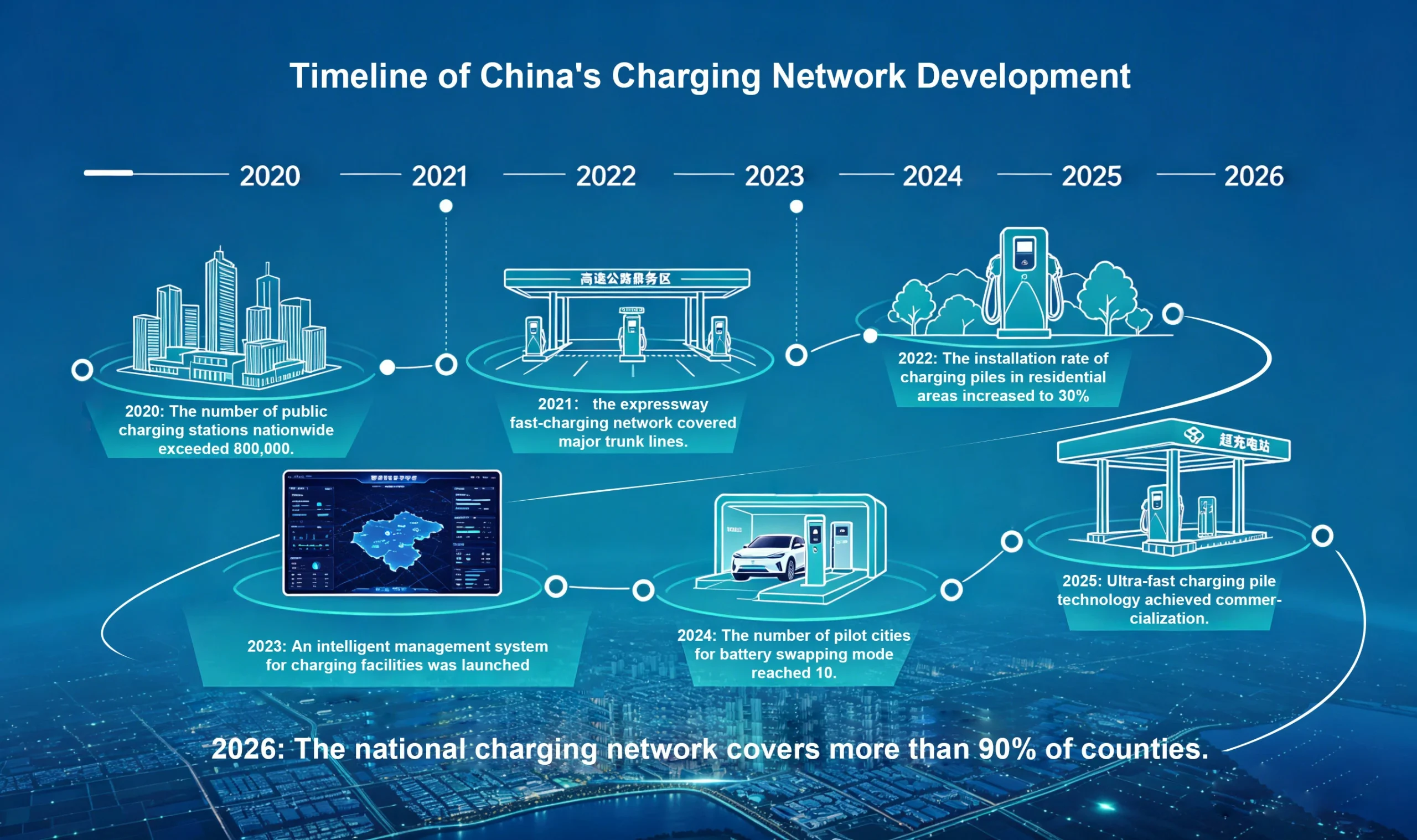
China’s EV fast charging network surpassed 21 million charging points in early 2026, more than the rest of the world combined, and is now pushing toward megawatt-class charging capable of a 10% to 70% top-up in five minutes. For infrastructure project developers and charging station operators sourcing equipment globally, these developments are not background noise. They are a signal about where commercial charging technology is heading, which manufacturers have been tested at scale, and what your next project should be specced to handle.
Consider what happened in Thailand in late 2025. A regional charging network operator had deployed 80kW DC chargers across a highway corridor, meeting the typical charging needs of the local EV fleet. Within 18 months, the mix of EVs on that road had shifted sharply toward Chinese-manufactured models with 150kW+ onboard charge acceptance. The operator’s stations were already becoming a bottleneck. Selecting equipment with real headroom, and from a supplier who understood how fast this market moves, would have changed that outcome.
China is where that market is moving fastest. Here is what operators need to understand.
Key Takeaways
- China reached 21.01 million EV charging points by February 2026, representing approximately 67% of the world’s public charging infrastructure, up 47.8% year-on-year.
- BYD’s 1,500kW Flash Charger, the most powerful mass-produced DC charger in the world, enables 10% to 70% charging in five minutes; BYD plans 20,000 stations across China by end-2026.
- The China EV charging market is valued at $37.61 billion in 2026, growing at 46.9% CAGR toward $257.1 billion by 2031.
- Proven commercial DC fast chargers in the 60kW to 320kW range remain the deployable backbone of public charging globally, even as megawatt technology advances.
- China exported 583,000 NEVs in January and February 2026 (+110% year-on-year), creating urgent charging infrastructure demand in receiving markets across Southeast Asia, Europe, and Latin America.
China’s EV Charging Network: Scale That Resets the Global Benchmark
No country has built EV charging infrastructure at the speed and scale of China. By the end of February 2026, China’s total charging points reached 21.01 million, a 47.8% year-on-year increase. Public charging facilities numbered 4.834 million, up 28.8%. The private charging network added another 16.176 million units, surging 54.6% year-on-year as home and workplace charging expanded alongside EV adoption.
21 Million Charging Points and What That Number Really Means
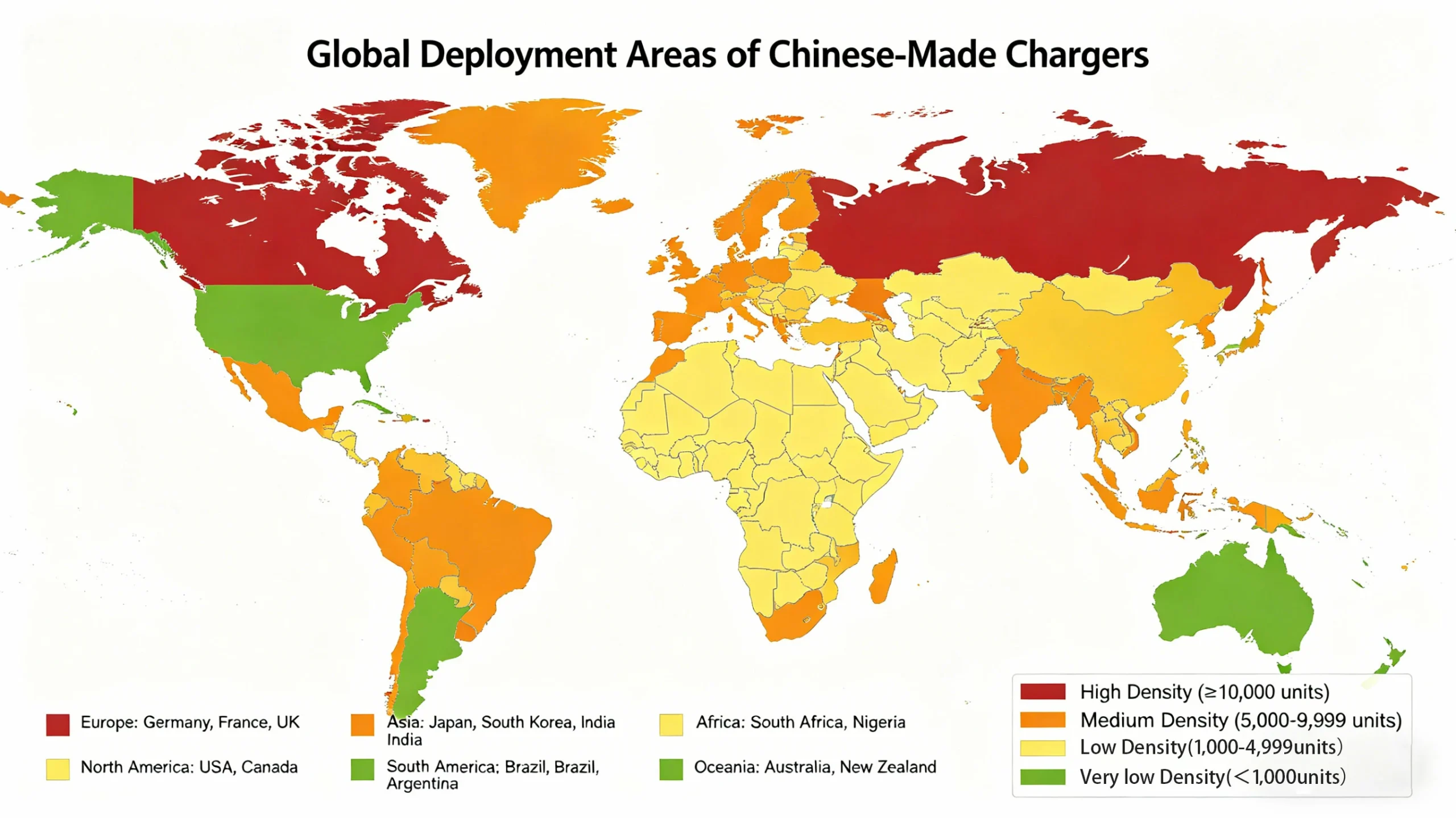
To put the scale in perspective: the United States had approximately 200,000 public EV charging ports at the same point in time. China operates more public fast chargers in a single province than the US has nationwide. This infrastructure gap is not closing at the current pace of Western deployment.
For operators and project developers outside China, the scale matters for a specific reason: equipment that has been deployed at tens of millions of units across China’s varied real-world conditions, urban parking structures, coastal highway corridors, high-altitude mountain routes, and subtropical climates, represents hardware that has been genuinely stress-tested. Manufacturing quality and field performance claims backed by that volume of deployment carry more weight than laboratory certifications alone.
Public Fast Charging Surges Ahead of the Average
Within China’s public network, the growth trend is clearly toward higher power. Stations rated above 150kW are expanding at a 26.41% compound annual growth rate as government subsidies and consumer preferences align around faster charge times. The Chinese government has set a target of more than 100,000 high-speed chargers installed across cities nationwide by 2027, treating rapid public charging as critical national infrastructure rather than optional convenience.
This policy direction mirrors a broader pattern now appearing in every market where EV adoption is accelerating: driver expectations for charge speed rise quickly once basic charging access becomes available. Operators who plan for 120kW+ as their baseline public offering, rather than retrofitting later, position their networks to remain competitive through the next expansion cycle.
China EV Fast Charging Technology: From Commercial DC to Megawatt Flash
The most prominent development in China’s charging landscape over the past 12 months has been the commercial arrival of megawatt-class charging. Understanding what this means, and what it does not mean for most infrastructure projects in 2026, is essential before making procurement decisions.
The Commercial Foundation: Proven DC Fast Chargers (60kW to 240kW)
Before examining megawatt headlines, it is worth anchoring to the commercial reality of most public charging deployments worldwide. The 120kW DC fast charger remains the most requested unit in global markets, offering a 20% to 80% charge in approximately 35 minutes, aligned with the dwell time of a shopping or dining stop.
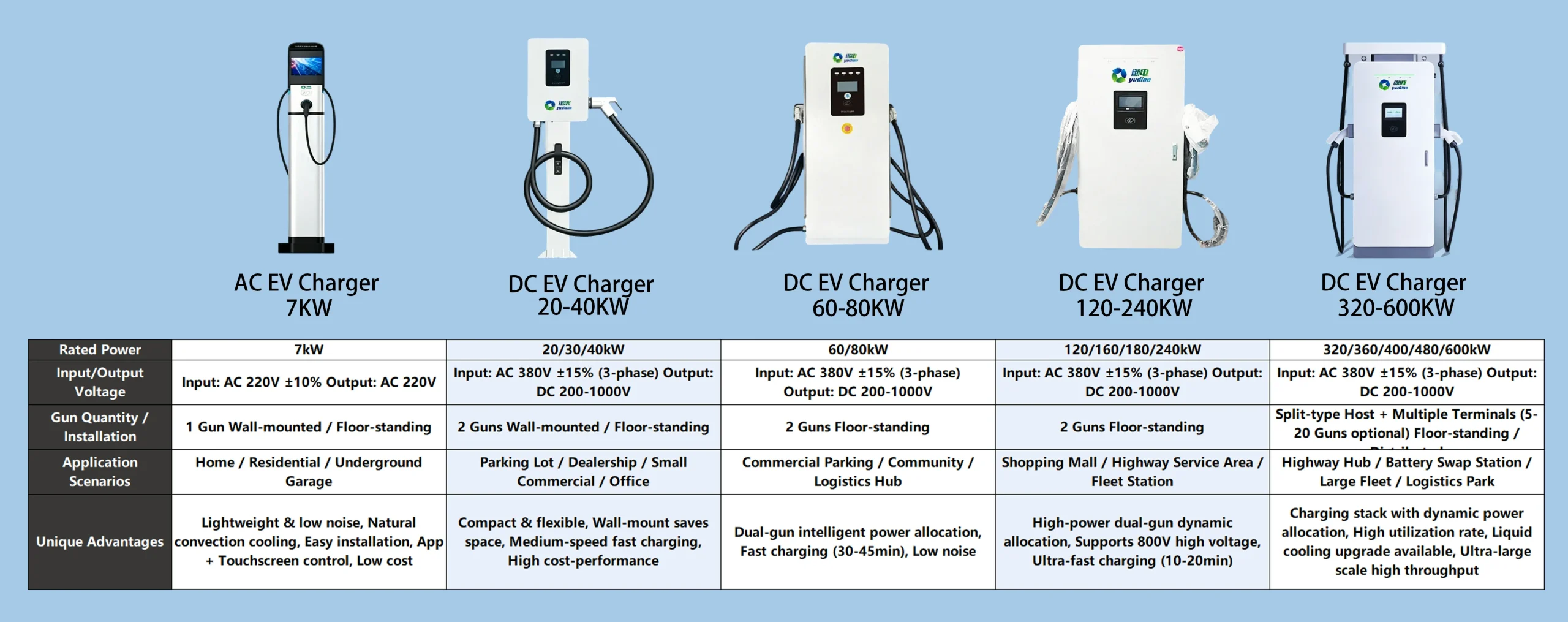
Yudian’s high-power DC fast charger range (120-240kW) covers this commercial sweet spot with proven reliability: 2.0mm thickened steel body construction, high-precision components with no recycled materials, and full OCPP 1.6J compliance for backend management integration. These are not aspirational products. They are units manufactured in a 20,000 m² dedicated facility, quality-inspected before shipment, and packed in industrial-grade wooden crates for safe arrival at international project sites.
For operators evaluating new station rollouts, the 60kW to 240kW range covers the vast majority of commercial, urban, and highway deployment scenarios with infrastructure that can be sourced, delivered, and commissioned within a standard project timeline.
Ready to review specifications for your project? Contact our engineering team to discuss power requirements, connector standards, and delivery timelines for your site.
BYD’s Megawatt Flash Charging: The Five-Minute Charge Era Begins
At the technology frontier, BYD has redefined global expectations for charging speed. In March 2026, the company launched its second-generation Flash Charger with a single-gun output of 1,500kW, a 50% increase over the first generation released in 2025. Vehicles equipped with BYD’s second-generation Blade Battery charge from 10% to 70% in five minutes.
BYD’s “Flash Charging China” initiative commits to 20,000 flash-charging stations nationwide by end-2026. Crucially, BYD is partnering with existing Chinese charging network operators for 18,000 of these sites, meaning the rollout requires no additional land acquisition or dedicated grid connection infrastructure at each location. BYD has also announced plans to extend flash-charging stations to international markets by late 2026.
Competitor Zeekr has demonstrated a fully liquid-cooled charger capable of 1,200kW per gun. CATL is preparing to reveal next-generation fast-charging technology tied to its new battery chemistry, signaling that this race involves multiple major players rather than a single brand breakthrough.
What Comes Next: Second-Generation Battery-Charger Integration
The near-term pipeline in China points toward co-engineering of battery management systems and charging hardware. Achieving reliable megawatt-level charging requires the battery and charger to communicate with precision that OCPP 1.6J’s smart charging profiles already support at lower power levels, but which demands tighter integration at megawatt speeds.
This has a practical implication for operators selecting commercial infrastructure today: hardware must be forward-compatible. OCPP 1.6J compliance ensures that commercial chargers can be managed and updated remotely as vehicle technology evolves, protecting the long-term value of deployed assets regardless of what charging speeds become standard in five years.
Government Policy and China’s Fast Charging Roadmap to 2030
China’s fast charging expansion is not organic market behavior alone. It is the product of sustained policy commitment that provides reliable context for operators and investors assessing the long-term trajectory.
Key policy signals for 2026 to 2030 include:
- 100,000+ high-speed charger mandate**: Government-directed installation of rapid public chargers across Chinese cities, with 2027 as the near-term milestone.
- Subsidy shift from EVs to infrastructure**: Government spending has moved away from vehicle purchase subsidies toward charging network buildout, a long-term infrastructure-first signal.
- Smart charging requirements for ultra-fast stations**: New regulations require operators of high-power stations to implement intelligent load management systems, making OCPP-compatible management platforms essential rather than optional.
- Grid upgrade co-investment**: State utility companies are co-investing in grid upgrades at high-density charging corridors, reducing the infrastructure barrier for private operators deploying 150kW+ stations in urban areas.
For operators developing projects in markets receiving Chinese EV exports, where BYD, Zeekr, Nio, and Xpeng vehicles are increasingly common, the policy environment in China directly shapes the charging expectations that those vehicle drivers carry with them.
Grid Challenges and Why Smart Charging Is No Longer Optional
The rapid deployment of ultra-fast charging stations is not without consequences for urban power grids. A peer-reviewed study published in Nature Communications documented how China’s urban ultra-fast charging is already distorting regulated electricity price signals and creating localized grid stability risks in dense deployment zones.
The arithmetic is straightforward: a single 1,500kW flash-charging station draws as much instantaneous power as a small city block. Deploying multiple high-power chargers without intelligent load scheduling creates peak demand events that grid infrastructure was not designed to absorb.
Huawei’s collaboration with the State Grid Corporation of China on AI-driven charging scheduling has demonstrated peak load reductions of up to 40% through dynamic power management across station clusters. The operational lesson is clear: high-power chargers without backend intelligence are not a viable commercial strategy at scale.
For operators building networks today, the practical path forward is selecting hardware with genuine OCPP 1.6J integration, enabling smart charging profiles, dynamic load balancing across multiple units, and remote diagnostics that reduce on-site maintenance costs. Our EV charging ROI guide from 7kW to 720kW covers how intelligent load management directly affects station payback periods and total operating costs.
What China’s Fast Charging Boom Means for Global Project Developers
The most direct implication of China’s charging acceleration for international operators is this: the equipment ecosystem proven at scale in China is now available for global deployment, backed by manufacturers with the export logistics and technical support infrastructure to deliver it reliably.
Southeast Asia, Latin America, and Europe: Where Chinese Chargers Are Going
China exported 583,000 NEVs in the first two months of 2026 alone, a 110% year-on-year increase. NEVs now account for 43.1% of China’s total vehicle exports. The markets absorbing these vehicles include Thailand, Indonesia, the Philippines, Brazil, Chile, and major European countries. Each is also facing an urgent charging infrastructure gap.
Operators developing public charging networks in these regions encounter a consistent procurement challenge: they need chargers that perform reliably in local climate conditions, ship safely over long distances, arrive with documentation for local regulatory compliance, and come with technical support for installation and commissioning.
This is where a manufacturer with genuine export experience provides measurable value. Yudian’s industrial-grade wooden crate packaging is designed specifically for international freight, protecting charger enclosures, cable assemblies, and display components through multi-modal shipping routes. Our team of 800+ engineers provides online and offline installation guidance that scales from single-unit deployments to multi-site rollouts.
If you are at the supplier evaluation stage, our China EV charger manufacturer buyer’s guide provides a structured framework for assessing factory quality, export readiness, and post-sales support capability, the factors that determine whether a charger performs as specified once it is deployed, not just when it leaves the factory.
Matching Charger Power to Real Project Needs in 2026
The megawatt tier grabs headlines, but most commercial projects in 2026 are best served by the proven commercial DC range. The table below maps power levels to realistic deployment scenarios:
| Power Output | Primary Application | Typical Charge Time | Infrastructure Requirement |
|---|---|---|---|
| 7kW AC | Residential / Workplace | 6–10 hours | Standard single-phase |
| 20–40kW DC | Small commercial / Fleet | 1.5–2 hours | Three-phase commercial |
| 60–80kW DC | Urban retail / Hospitality | 45–75 minutes | Standard three-phase |
| 120–240kW DC | High-traffic public stations | 20–35 minutes | Upgraded commercial supply |
| 320–600kW DC | Highway hubs / Bus depots | 8–20 minutes | High-voltage dedicated supply |
| 1,000kW+ (megawatt) | Emerging mega-hubs | 5–10 minutes | Major grid infrastructure |
Yudian’s 320-600kW liquid-cooled DC charger addresses the upper end of commercially viable fast charging, suitable for highway rest stops, fleet depot charging, and high-turnover public hubs, without requiring the extraordinary grid infrastructure that megawatt-class systems demand. For most projects in 2026, this range represents the practical ceiling before civil and grid costs begin to outpace the revenue benefits of faster charging.
FAQ: China EV Fast Charging Explained
Q:How many EV charging stations does China have in 2026?
China’s total EV charging points reached 21.01 million as of February 2026, including 4.834 million public charging facilities. This represents approximately 67% of global public EV charging infrastructure, reflecting 47.8% year-on-year growth driven by both public network expansion and private workplace and residential installations.
Q:What is the fastest EV charging speed available in China right now?
BYD’s second-generation Flash Charger, launched in March 2026, delivers up to 1,500kW per charging gun, enabling compatible vehicles to charge from 10% to 70% in approximately five minutes. Zeekr has also demonstrated a 1,200kW liquid-cooled charger. These megawatt-class units are in early commercial deployment; the majority of public fast charging in China still uses 60kW to 240kW DC chargers, which represent the proven commercial standard.
Q:Are Chinese DC fast chargers available for projects outside China?
Yes. Experienced Chinese DC fast charger manufacturers export 20kW to 600kW units to projects across Southeast Asia, the Middle East, Europe, and Latin America. Export-ready products include industrial-grade protective packaging for international freight and OCPP 1.6J compliance for integration with local charging management platforms.
Q:How does China’s EV charging network compare to the US and Europe?
China hosts approximately 67% of the world’s public EV chargers and is expanding at a pace no other country has matched. The US had approximately 200,000 public charging ports as of early 2026. Europe has been growing rapidly but remains well behind China in total installed infrastructure. Both the per-vehicle charger ratio and average charger power level are higher in China than in most Western markets.
Q:What should operators consider when specifying a DC fast charger for an international project?
The key criteria are: available grid capacity at the site, expected vehicle dwell time and turnover rate, connector standards for the local vehicle population (CCS1, CCS2, CHAdeMO, GB/T), OCPP 1.6J compliance for management platform integration, outdoor protection rating (IP54 minimum for most environments), and supplier packaging and logistics capability for safe international delivery.
Conclusion: Building Today for the Charging Expectations of Tomorrow
China’s EV fast charging developments in 2026 are setting a new global baseline, in infrastructure scale, charging speed, and the policy commitment that sustains both. The five-minute charge era is arriving. The infrastructure that supports it will be built by operators who choose reliable, OCPP-compatible commercial chargers today, deploy them with intelligent backend management, and partner with manufacturers who understand what real-world international deployment requires.
The transition from 150kW to megawatt-class charging will take years to reach most markets outside China. The operators who use that window to build well, with proven hardware, smart management, and experienced supplier support, will be positioned to scale effectively when faster charge acceptance becomes the market norm.
Yudian’s engineering team is ready to support your charging project from specification through commissioning. Contact us to discuss your requirements to find the right solution for your site.