
The right China EV charger manufacturer delivers certified, durable hardware, reliable global delivery, and engineering support that keeps your project on schedule. The wrong one ships equipment that fails certification checks, arrives damaged, or leaves you without technical guidance after the sale. With over 2,000 suppliers listed on sourcing platforms and the global EV charging market projected to reach $452.2 billion by 2030, demand is rising fast; but so is the gap between manufacturers who can genuinely support international projects and those who cannot. This guide gives you a practical, criteria-based framework for finding a supplier you can trust. Key Takeaways
- China manufactures 60-70% of global EV charger production capacity, making it the logical sourcing destination, but quality varies significantly between suppliers.
- Verify certifications (CE, TUV, UL, ISO9001) before any purchase; ask for actual test reports, not just certificates displayed on a website.
- A genuine manufacturer operates an in-house factory with dedicated engineers; a trading company resells products it did not build, with limited ability to customize or support you.
- Build quality standards matter: look for 2.0mm+ steel body construction, IP54 or higher protection rating, and full-load aging tests before shipment.
- OCPP 1.6J compliance is non-negotiable for commercial charging projects that require backend software integration.
- Industrial-grade packaging, not standard cardboard, is the difference between chargers that arrive ready to install and those that arrive damaged.
Why China Leads Global EV Charger Manufacturing
China produces the majority of EV chargers deployed worldwide. According to Statista’s EV charging infrastructure data, China accounts for an estimated 60-70% of global DC module production capacity. No other country comes close.
This dominance is not accidental. Chinese manufacturers have invested heavily in vertical integration, building large-scale factories with in-house R&D, dedicated testing laboratories, and engineering teams that can support international standards. In January and February 2026 alone, China exported 583,000 new energy vehicles — a 110% year-on-year increase — and the demand for compatible charging infrastructure followed immediately.
The result: global project developers, charging station operators, and fleet managers increasingly look to China not as a last resort, but as a first choice for reliable, cost-effective EV charging hardware. The country has also set a national target to install over 100,000 high-speed chargers in cities by 2027, driving continued technology investment.
For buyers, this scale is an advantage. A well-selected one-stop intelligent charging solution from an established Chinese manufacturer gives you access to a full AC and DC product range, integrated software, and a factory-direct supply chain — without the complexity of managing multiple suppliers.
The challenge is separating ev charger manufacturers in China who have earned that trust from the many who have not.
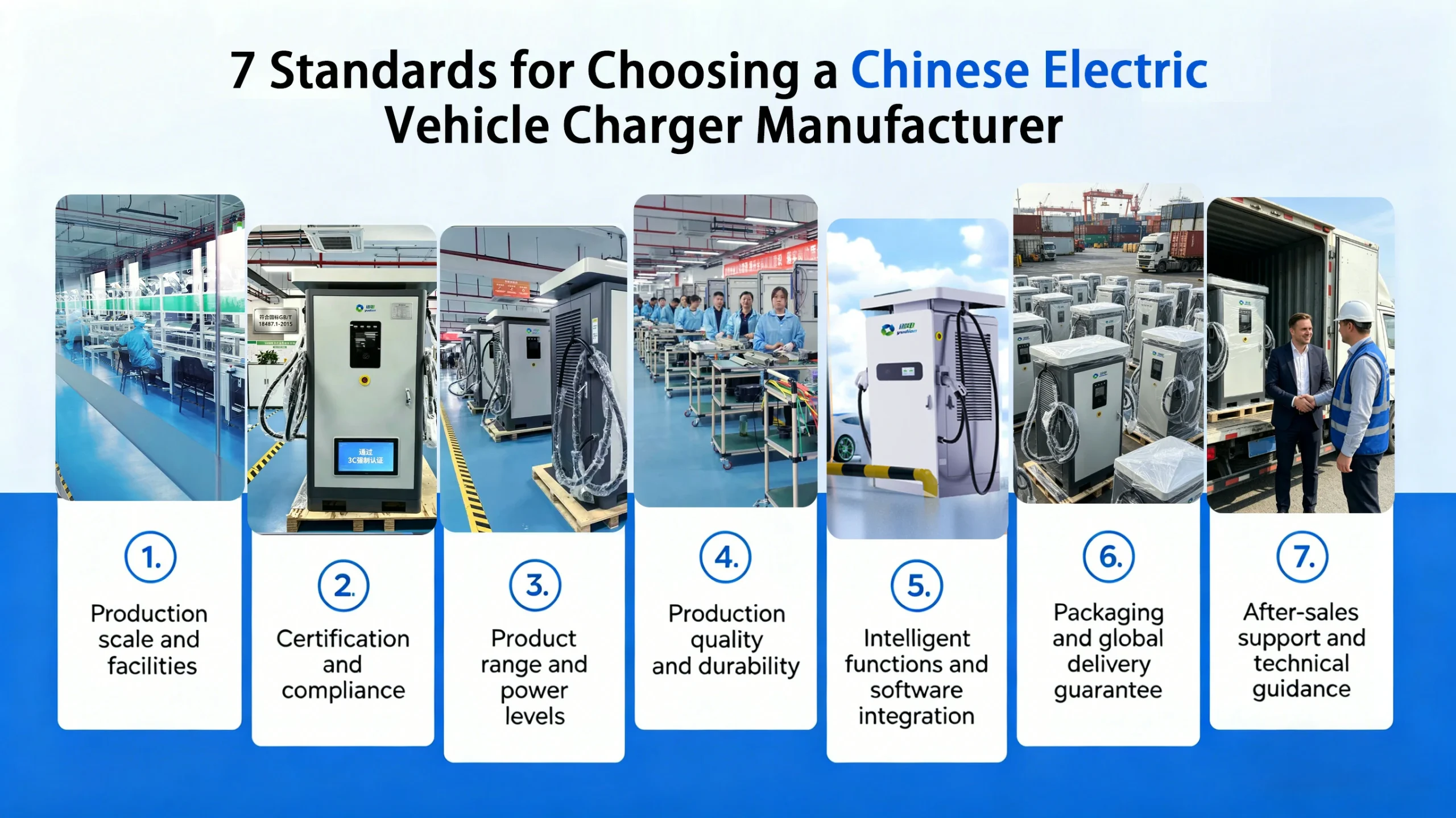
7 Criteria for Evaluating a China EV Charger Manufacturer
1. Manufacturing Scale and Facility
The first question to ask any prospective supplier: are you a manufacturer or a trading company?
Trading companies source products from third-party factories, relabel them, and resell at a margin. They cannot modify specifications, guarantee consistent quality, or provide genuine technical support. When problems arise after delivery, they have limited use with the actual factory.
A genuine china ev charger manufacturer operates its own production facility. Key indicators include:
- A verifiable factory address (cross-reference with satellite maps and factory tour videos)
- On-site engineering and R&D teams
- In-house SMT lines, assembly stations, and testing equipment
- ISO 9001 certification, which requires documented quality management processes throughout production
Factory scale matters too. A 20,000-square-meter facility with dedicated research centers and multiple laboratories has the infrastructure to maintain consistent quality across large orders. A smaller operation may struggle with batch consistency, especially under high-volume export demand.
When James, a charging station operator based in Southeast Asia, placed his first order with a Chinese supplier in 2024, he assumed any company listing “manufacturer” on its Alibaba profile was a genuine factory. Three months later, the chargers arrived with inconsistent build quality — some units had loose cable terminations, others had mismatched connector fittings. He traced the problem back to the fact that his “manufacturer” was actually a trading company sourcing from three different sub-contractors. The reorder with a verified factory cost him a quarter of what he spent resolving the first shipment’s warranty claims.
What to verify: Request a factory audit, a virtual factory tour, or ask for photos of the production line and testing equipment with timestamped metadata.
2. Certifications and Compliance
Certifications are your insurance policy. Import a batch of uncertified EV chargers into the EU, UK, or North America and you face customs seizure, legal liability, and reputational damage. Certifications are not optional.
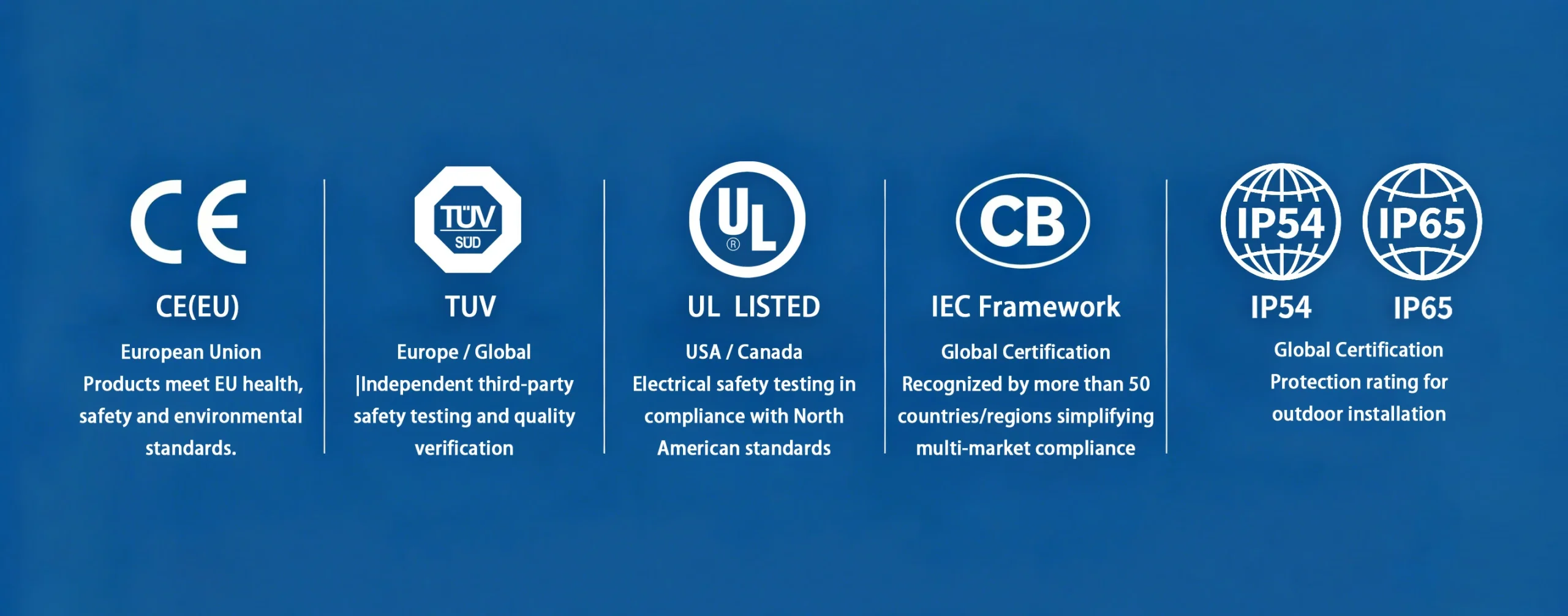
Here is what each key certification means for global buyers:
| Certification | Region / Requirement | What It Verifies |
|---|---|---|
| CE | European Union | Product meets EU health, safety, and environmental standards |
| TUV | Europe / Global | Independent third-party safety testing and quality verification |
| UL | United States / Canada | Electrical safety testing to North American standards |
| CB | Global (IEC framework) | Recognized in 50+ countries, simplifies multi-market compliance |
| ISO 9001 | Global | Quality management system covering production consistency |
| IP54 / IP65 | Global | Ingress protection rating for outdoor installation |
Beyond the hardware certifications, verify connector standard compliance for your target market:
- CCS1 (SAE J1772 + DC combo): United States
- CCS2: European Union, UK, Australia
- CHAdeMO: Japan, certain legacy markets
- GB/T: China domestic market
- Type 2 (IEC 62196): European AC charging
A credible ev charger manufacturer in China will provide actual test reports from recognized labs — TUV, UL, SGS, or Intertek — not just certificate images. Always ask for the full report with the test date, model number, and lab reference number.
3. Product Range and Power Levels
Matching hardware to use case is one of the most consequential decisions in any charging project. A manufacturer with a narrow product range forces you to work with multiple suppliers as your network grows.
For most global projects, the relevant tiers are:
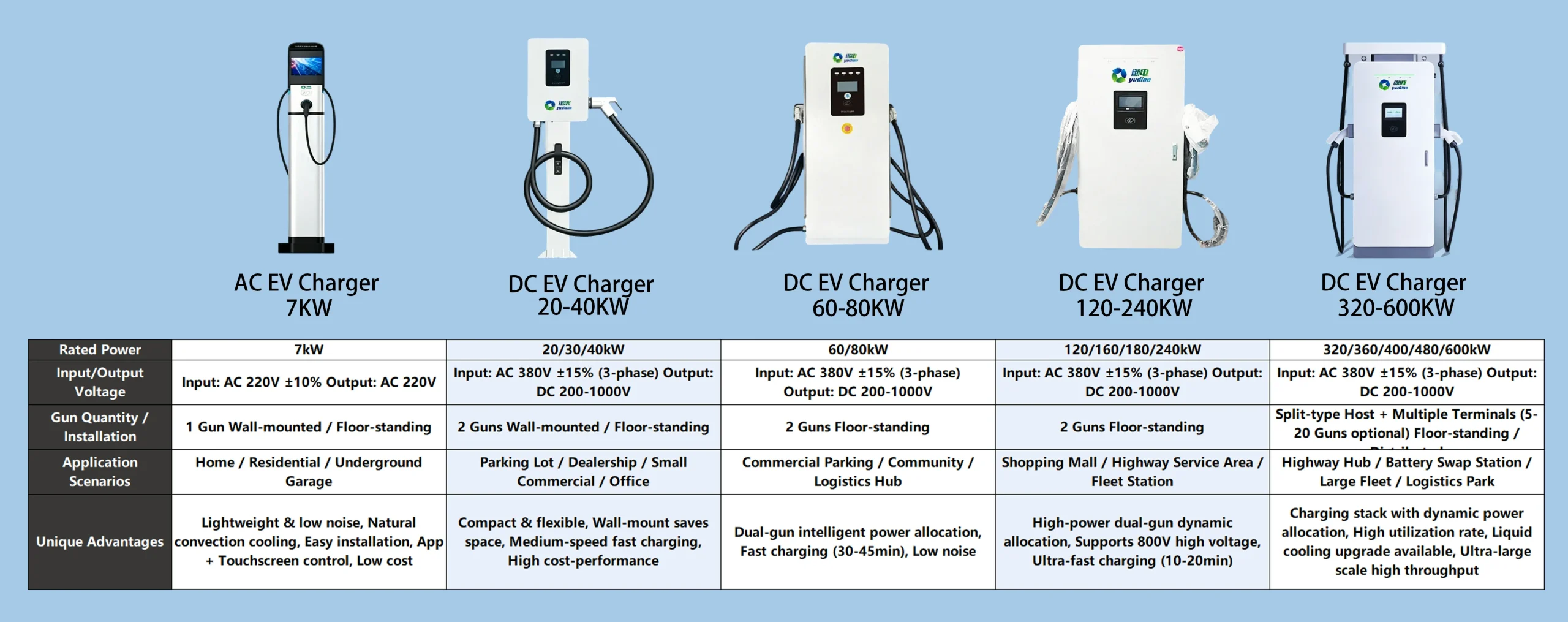
AC Charging (7kW-22kW)
Designed for long-dwell locations: apartments, offices, hotels, and destination charging. Lower upfront cost, but sessions typically run 4-8 hours. Ideal for overnight charging in residential and workplace settings.
Entry-Level DC Fast Charging (20kW-40kW)
A 20-40kW DC fast charger delivers meaningful charge in 1-2 hours. Suited to dealerships, small retail locations, and private fleet depots where dwell time is predictable and controlled.
Commercial DC Fast Charging (120kW-240kW)
The 120-240kW DC EV charger is the most requested specification for urban commercial projects globally. A 20% to 80% charge in approximately 35 minutes aligns with typical shopping center or petrol station dwell time, maximizing station utilization and revenue.
Ultra-Fast / Mega-Hub (320kW-600kW+)
Liquid-cooled high-power systems for highway service areas, bus terminals, and heavy-duty fleet depots. High capital expenditure, but premium throughput enables strong margins through fast vehicle turnover.
Look for a manufacturer that covers the full spectrum. Switching suppliers mid-project because your original vendor cannot supply a higher-power tier creates procurement delays, inconsistent warranty coverage, and potentially incompatible software ecosystems.
4. Build Quality and Durability
EV chargers are outdoor infrastructure assets expected to operate reliably for 10 or more years. The difference between a charger that achieves that lifespan and one that fails within 18 months often comes down to materials and manufacturing standards that are invisible at the point of purchase.
Key quality indicators to evaluate:
Steel body thickness: Look for a minimum of 2.0mm thickened steel body construction. Thinner gauge steel is cheaper to manufacture but degrades significantly faster under UV exposure, rain, and temperature cycling. High-precision construction with no recycled materials in the electrical components ensures stable, accurate performance over time.
IP and IK ratings: IP54 is the minimum acceptable for most outdoor installations; IP65 provides full dust exclusion and directed water protection. IK10 impact protection ensures the enclosure withstands physical impact — relevant for public-facing stations in high-traffic areas.
Quality control processes: Ask specifically about IQC (incoming component inspection), IPQC (in-process checks during assembly), and OQC (100% full-load aging tests before final packaging). A manufacturer running 4+ hour aging tests on every unit before shipment catches latent defects before they become your problem.
Multiple safety protections: Verify the charger includes over-voltage, undervoltage, overcurrent, short circuit, leakage, and lightning surge protection. These are not optional features — they determine whether your charger survives real-world grid conditions.
5. Smart Features and Software Integration
A charger that cannot integrate with your management platform is a liability, not an asset. For any commercial charging project, OCPP 1.6J protocol compliance is the non-negotiable baseline.
OCPP 1.6J (Open Charge Point Protocol) uses JSON over WebSockets to establish a persistent, lightweight communication channel between your charging hardware and your backend management system (CMS). This means:
- You can switch CMS providers without replacing hardware
- Real-time status monitoring and fault alerts are available remotely
- Smart charging profiles (load balancing, time-of-use pricing) can be pushed to the charger remotely
- Over-the-air firmware updates eliminate the need for site visits for most maintenance events
Beyond OCPP compliance, look for manufacturers whose software supports app-based scheduling, remote monitoring, and clear power reporting. These features reduce operational complexity and give station operators the visibility they need to manage daily performance efficiently.
Ready to evaluate OCPP-compliant options for your project? Contact the Yudian team for a technical consultation on the right specifications for your use case.
6. Packaging and Global Delivery Assurance
Shipping EV chargers internationally — especially DC fast chargers weighing 80-300kg — creates real damage risk. Standard cardboard packaging is insufficient for sea freight across 20,000km with multiple handling points. Yet most articles comparing Chinese EV charger manufacturers never mention packaging at all.
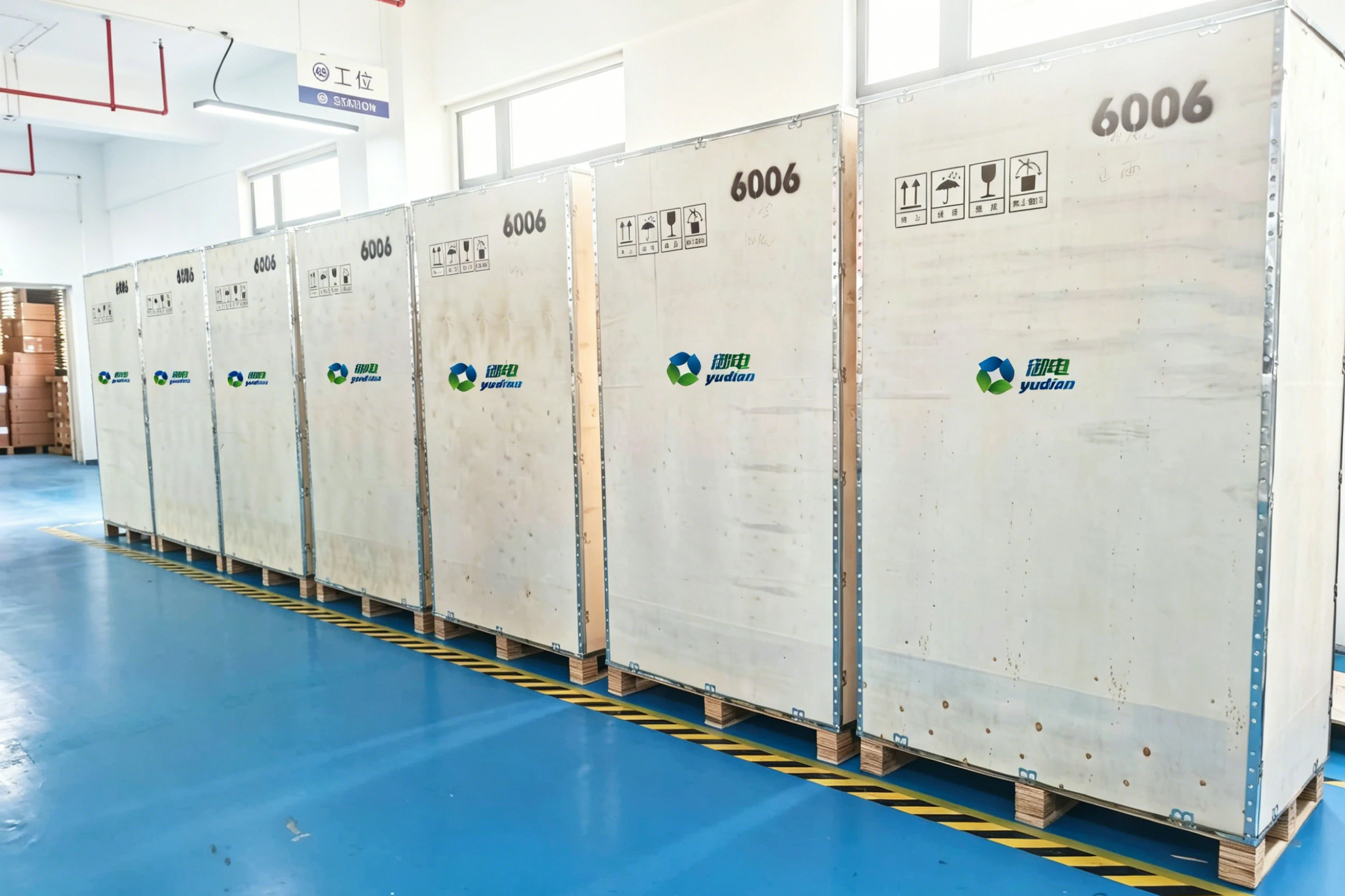
Industrial-grade wooden crate packaging, with internal foam bracing and moisture-wicking desiccant, is the standard that protects hardware through long-distance sea freight. Ask your prospective manufacturer:
– What is the standard packaging specification for your DC chargers?
– Do you include shock-absorbing internal support?
– Can you provide photos of packaged units ready for export?
A manufacturer that takes packaging seriously is a manufacturer that understands international logistics. It is a reliable indicator of broader operational professionalism.
Equally important is delivery documentation: commercial invoices, packing lists, certificates of origin, and product certification documents all need to be accurate and complete to avoid customs delays.
7. After-Sales Support and Technical Guidance
The sales conversation is straightforward. What distinguishes long-term partners from transactional suppliers is what happens after the purchase order is signed.
Evaluate the support offering on these dimensions:
Engineering team size and accessibility: A manufacturer with 800+ professional engineers on staff can provide genuine online and offline installation guidance. A small trading operation cannot.
Documentation quality: Is technical documentation available in English? Are installation manuals comprehensive? Are wiring diagrams and commissioning guides included?
Response time commitments: For commercial projects, a 24-48 hour technical response window is reasonable. Ask for reference contacts from previous international projects.
Spare parts availability: Confirm that replacement parts (connectors, displays, power modules) are available and can be shipped internationally. Chargers that cannot be repaired locally become expensive write-offs.
Red Flags When Vetting a China EV Charger Manufacturer
Not every supplier listing themselves as a China EV charger manufacturer deserves the title. When evaluating any chinese ev charger supplier, the following warning signs should end the conversation immediately. Watch for these warning signs:
- No verifiable certifications: Certificate images without traceable lab report numbers are meaningless. Request the full test report.
- Vague product specifications: Legitimate manufacturers provide precise technical datasheets. If specifications are listed as ranges without model-specific detail, the product may not exist in the form advertised.
- No English technical documentation: International buyers need English installation manuals, commissioning guides, and wiring diagrams. Absence of these suggests limited international supply experience.
- No dedicated engineering team: If the company cannot connect you with an engineer for a pre-sale technical conversation, post-sale support will be equally inaccessible.
- Prices significantly below market: Genuine 2.0mm steel construction, certified components, and full-load aging tests have real costs. A price 40-50% below comparable verified manufacturers is a quality signal, not a buying opportunity.
What Sets a Reliable EV Charging Partner Apart
In 2026, the Chinese EV charger manufacturing landscape includes a small number of genuinely capable partners and a much larger number of companies that cannot consistently deliver on international project requirements. Yudian’s manufacturing expertise — built over 20+ years, across a 20,000-square-meter dedicated factory with 800+ professional engineers — reflects what a serious supplier should look like.
The combination that global buyers should look for: a full AC and DC product range (from 7kW to 720kW), OCPP 1.6J-compliant smart management, 2.0mm thickened steel construction with no recycled materials, rigorous quality inspection at every production stage, and industrial-grade packaging designed specifically for international sea freight.
When a European infrastructure developer contacted Yudian in late 2025 for a 200-unit DC charging station rollout, their primary concern was not price — it was consistency. They needed every unit to arrive certified, undamaged, and ready for installation by a local contractor. After auditing the factory remotely and reviewing TUV test reports for the target model, they placed the order. Every unit arrived with installation documentation, passed local grid inspection on first attempt, and was live within the scheduled deployment window.
That outcome is what the right china ev charger manufacturer makes possible.
Frequently Asked Questions
Q:What certifications should a China EV charger manufacturer have for export?
At minimum: CE (for the EU), UL or ETL (for North America), TUV or CB (for broad international markets), and ISO 9001 for quality management. The specific set depends on your target markets. Always request full test reports from the certifying lab, not just certificate images.
Q:How do I verify a Chinese EV charger factory is legitimate?
Ask for the business license, a virtual factory tour, production line photos with metadata, and direct contact with an engineer. Cross-reference the factory address on Google Maps or Baidu Maps. Request references from previous international buyers and verify them independently.
Q:Can Chinese EV charger manufacturers customize products for my market?
Yes, genuine manufacturers with in-house R&D can customize connector types, power output, enclosure colors, branding, software interfaces, and documentation. Trading companies typically cannot. Clarify early in discussions whether the product you need is a standard catalog item or requires engineering input.
Q:What power levels are available from Chinese EV charger manufacturers?
The full commercial range covers AC chargers from 7kW to 22kW and DC fast chargers from 20kW to 720kW including liquid-cooled ultra-fast models. Explore the full range of EV chargers to match power output to your specific use case.
Q:How long does shipping take from a China EV charger manufacturer?
Sea freight from major Chinese ports (Shenzhen, Shanghai, Ningbo) to Europe typically takes 25-35 days; to North America’s West Coast, 15-20 days; to Southeast Asia, 7-14 days. Air freight significantly reduces transit time but increases cost substantially for heavy DC units. Confirm lead times with your supplier before committing project installation schedules.
Q:What is a typical minimum order quantity?
This varies significantly by manufacturer and product type. Many Chinese EV charger manufacturers will ship single units for sample evaluation, with volume pricing applying from 5-10 units. Large commercial orders typically receive dedicated project management and packaging customization.
Conclusion: Make the Right Choice Before the Purchase Order
China’s position as the world’s leading ev charger manufacturer creates real opportunities for global charging projects — better hardware specifications at competitive price points, backed by genuine manufacturing scale and engineering expertise. But the quality gap between suppliers is wide, and choosing on price alone is the single most reliable path to a failed project.
Use the 7 criteria in this guide as your evaluation framework: manufacturing scale, certifications, product range, build quality, software integration, packaging, and after-sales support. A supplier who can answer confidently on every dimension has earned a place in your project. One who cannot is a risk your deployment timeline cannot afford.
Browse Yudian’s full range of EV chargers to see the complete AC and DC lineup — from 7kW destination chargers to 600kW liquid-cooled fast charging systems — all built to the standards global projects demand. Ready to discuss your specific requirements? Get in touch with our engineering team for a project consultation and quote.
Sources:
- Electric Vehicle Charging Infrastructure in China | Statista (https://www.statista.com/topics/10465/electric-vehicle-charging-infrastructure-in-china/)
- China EV Market Shifts to High-Tech Focus in 2026 | EV Infrastructure News (https://www.evinfrastructurenews.com/ev-technology/china-ev-market-high-tech-focus-2026-price-floor-ends-subsidy-wars)
- EV Charger Manufacturers & Suppliers, China | Made-in-China.com (https://www.made-in-china.com/manufacturers/ev-charger.html)