
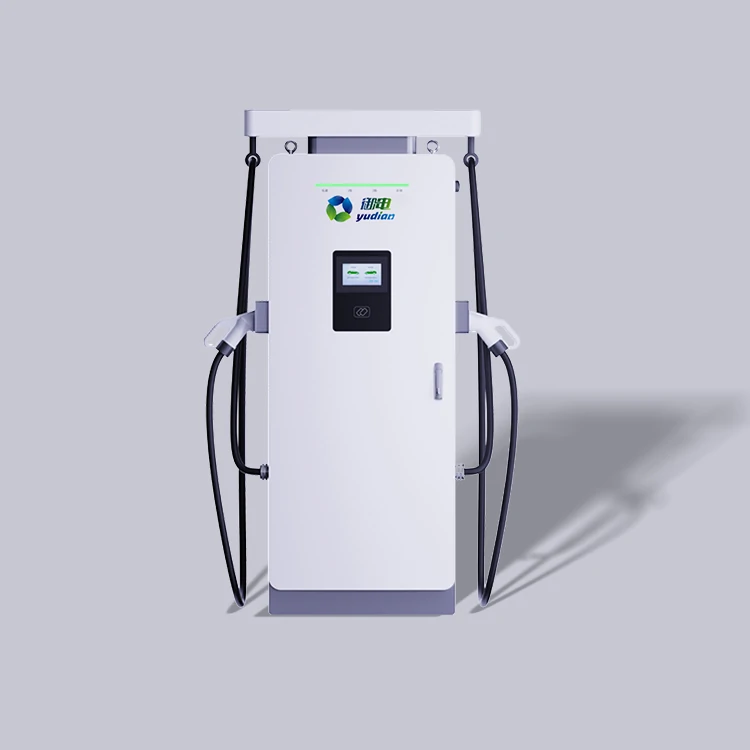
The DCP-D320/360/400/480/600 series DC fast chargers are designed for high-speed charging of electric passenger vehicles. Ideal for deployment at EV charging/swapping stations, public parking lots, residential complexes, and large commercial building parking facilities, they deliver reliable DC power to EV traction batteries.
This product is compatible with all electric vehicles complying with GB/T 20234.3 (charging interface standard) and GB/T 27930 (BMS communication standard), ensuring seamless interoperability and safe charging.
DC EV Charger 320-600KW
Description
1 Summary
1.1 Model Description
DCP: Integrated dual-gun DC fast charger series
D320/360/400/480/600: Rated output power options
1.2 Product Overview
The DCP-D series EV DC charger delivers safe, reliable, national standard compliant charging services with an excellent user experience. It integrates 7 core functional units for precise metering, data storage, and flexible configuration.
7 core functional units:
- AC distribution unit
- Power conversion unit
- DC output unit
- Charging interface
- Charging control unit
- Billing authentication unit
- User terminal
Usage Environment
Altitude ≤ 2000 m
Relative humidity: 5% ~ 95% (non-condensing)
Installation: Vertical, maximum tilt ≤ 5°
Environment: Protected from wind/sand/rain/snow; no corrosive/explosive gases or strong vibration
1.3 Performance parameters
Table 1-1 DCP-D320/360/400/480/600 electric vehicle DC fast charger performance parameters.
| Project | Technical indicators | |
|---|---|---|
| Product model specifications | DCP-D320/360/400/480/600 | |
| Input characteristics | Input Voltage | AC380V(1±15%) Three-phase five-wire |
| AC frequency | 50±1Hz | |
| Power Factor | ≥ 0.98 | |
| Current harmonic distortion | THDi ≤ 5% | |
| Full load efficiency | ≥ 96% | |
| Output characterlstics | Rated output power | 320/360/400/480/600kW |
| Output voltage range | DC200-1000V | |
| Output current range | Single circuit: O-250A | |
| Current limiting adjustment range | 20%~100% Rating | |
| Voltage stabilization accuracy | ≤ ±0.5% | |
| Steady flow accuracy | ≤ ±1%(Current range 20%-100% load) | |
| Ripple factor | Effective value coefficient:≤ 0.5% | |
| Protection features | Input over-voltage protection | When the input voltage is higher than the over-voltage protection setting value, the charger can automatically protect |
| Input under-voltage protection | When the input voltage is lower than the under-voltage protection setting value, the charger can automatically protect | |
| Output over-voltage protection | When the output voltage exceeds the over-voltage setting value, the charger can automatically protect | |
| Output short circuit protection | When the output is short-circuited, the charger can automatically protect itself and automatically recover when the fault point is removed. | |
| Over temperature protection | When the internal temperature of the charger exceeds theover-temperature setting value, the charger can automatically protect | |
| Communication protection | Shutdown of electric vehicle communication failure | |
| Human Machine Interface | Status indicator | Displays standby, charging and fault status |
| Human machine operation unit | Equipped with 8-inch LCD touch screen: display charging information, battery information, human-machine operation interface | |
| Others | Vehicle Auxiliary Power Supply Specifications | DC 12V/10A |
| Operating ambient temperature | -25℃ - +55℃ | |
| Cooling method | Forced air cooling | |
| Acoustic noise | ≤65 dB | |
| Protection level | IP54 | |
| Size (mm) | 320/360/400/480/600KW:2017 (Height)*980(Width)*1064(Depth) (Top width 1230mm) | |
2 Core Features
2.1 Basic Functions
Multi-Battery Compatibility: Supports lithium-ion, nickel-metal hydride, and lead-acid batteries, compatible with most common EV models.
Intuitive Operation: Full touchscreen HMI with convenient operation and clear status indication.
Integrated Capabilities: Combines card encryption, metering & billing, backend communication, and EV communication functions.
2.2 Safety Protection
Comprehensive Safety Mechanisms: Full electrical protection suite, with automatic fault detection and alarm.
Emergency & Interlock Safety: Equipped with an emergency stop switch for immediate power cutoff; charging only starts after secure connection to the vehicle’s traction battery system, with automatic stop and lock release if abnormal connection is detected.
BMS Real-Time Monitoring: Communicates with vehicle BMS to prevent overcharge, over-temperature, and reverse polarity, ensuring battery and vehicle safety.
Misoperation Prevention: Clear status indicators and text prompts to avoid operator errors.
2.3 Metering & Billing
Accurate Energy Measurement: Built-in DC energy meter for precise charging power calculation.
Flexible Billing: Supports time-of-use electricity pricing for automatic fee settlement.
Payment Methods: Offers settlement via charging cards and QR code scanning; card operations are restricted to management and O&M personnel (not for customer use).
2.4 Communication
BMS Communication: Verifies connection status and retrieves charging parameters and real-time data from the vehicle’s battery system.
Remote Monitoring: Two-way communication with upper-level systems to upload energy, fee, and IC card data, and accept remote control commands.
2.5 Historical Data Recording
Power-Off Data Protection: Prevents charging data loss during accidental power outages.
Event Logging: Records the most recent alarm events, parameter modification events, and charging events (name + start time).
FAQ
Q1: What is a “Charging Stack” and how does it differ from a standard DC pile?
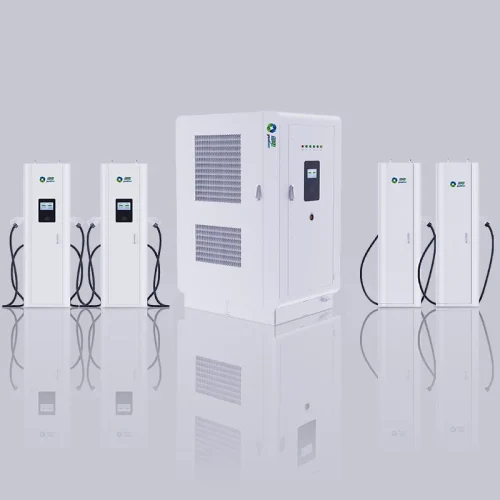
A: Unlike a standalone DC pile where the power module and charging gun are in one unit, a Charging Stack (or split-type system) consists of a centralized Power Bank (Host) and multiple Charging Terminals. This allows for massive power (up to 600kW) to be dynamically distributed across several parking spots, significantly improving space efficiency and power utilization.
Q2: How many vehicles can be charged simultaneously?
A: Depending on the configuration, a single power host can support between 5 to 20 charging terminals. The system utilizes Intelligent Dynamic Power Allocation, meaning it automatically directs more power to vehicles that can handle higher charging speeds or need a faster top-up, while balancing the load across all connected cars.
Q3: What charging standards are supported?
A: These high-power stacks are designed for global versatility and typically support:
-
CCS1 / CCS2 (European and American standards)
-
GB/T (Chinese National Standard)
-
CHAdeMO (Japanese standard)
-
Optional AC Type 2 for hybrid or lower-speed auxiliary charging.
Q4: Does this system support “Super Charging” and Liquid Cooling?
A: Yes. While standard terminals use forced air cooling, the 600kW high-capacity system can be upgraded to support Liquid-Cooled Super Charging. This allows a single gun to deliver extremely high currents (up to 500A or 600A), enabling compatible EVs to gain hundreds of kilometers of range in just 5–10 minutes.
Q5: What is the output voltage range?
A: The system supports an ultra-wide output voltage range of 150V to 1000V DC. This makes it future-proof, as it can charge both standard 400V battery systems and the newer 800V high-voltage platforms found in premium EVs and electric buses.
Q6: What are the primary application scenarios for 320kW-600kW stacks?
A: These systems are engineered for high-throughput environments, including:
-
Public Highway Fast-Charging Stations: Where rapid turnover is essential.
-
Bus & Logistics Depots: For overnight or “opportunity” charging of large fleets.
-
Industrial Parks: Centralized charging infrastructure for employee and company vehicles.
-
Urban Charging Hubs: Providing concentrated charging power in high-density areas.
Q7: How is the system managed and monitored?
A: The stack is fully compatible with OCPP 1.6J (upgradable to OCPP 2.0), allowing for seamless integration with third-party management platforms. It supports:
-
Connectivity: 4G, Ethernet, and Wi-Fi.
-
Remote Diagnostics: Real-time monitoring of power modules and terminal status.
-
Payment Integration: Mobile App, RFID cards, and QR code scanning.
Q8: What safety and durability features are included?
A: Built for heavy industrial use, the system includes:
-
Protection Rating: IP54 or IP55 for outdoor durability.
-
Safety Protections: Over/under voltage, overcurrent, short circuit, leakage protection, and lightning surge protection.
-
Cable Management: Many models feature a cantilever or retractor design to prevent cables from dragging on the ground, reducing wear and improving user experience.
-
Emergency Stop: Each terminal is equipped with a dedicated emergency shutdown button.
Q9: Can the system be expanded in the future?
A: Yes. The modular design is a key advantage. You can start with a 320kW power bank and add more power modules or charging terminals as your fleet or customer base grows, protecting your initial investment.
Additional information
| Weight | 576 kg |
|---|---|
| Dimensions | 1360 × 1180 × 2140 cm |
Mafer –
Didn’t expect such great value from a charger at this price. It’s been solid for 6 months with my Tesla, charges fast, and the app is actually easy to use. Shipping was quicker than I thought. Really happy with this purchase.