
Importing EV chargers from China involves six key steps: defining your technical requirements, selecting a certified manufacturer, verifying certifications for your destination market, placing a sample order, managing customs clearance, and arranging logistics to your project site. Done correctly, buyers can access professional-grade EVSE at 40-60% lower cost than comparable Western-manufactured alternatives — without compromising on quality or compliance.
Global demand for EV charging infrastructure is accelerating. China manufactures the majority of the world’s EV charging equipment, supplying markets across Europe, North America, the Middle East, and Southeast Asia. Yet most first-time importers lose time and money on uncertified products, incorrect tariff calculations, or logistics they did not plan for. The right manufacturer is out there — the challenge is finding and vetting them effectively.
This guide covers everything you need to know: country-specific certification requirements, real tariff rates (including the critical distinction between EV vehicle tariffs and EVSE tariffs), a manufacturer vetting framework, pricing benchmarks, and shipping logistics — so you can import ev chargers from China with confidence.
Key Takeaways
- EV chargers (EVSE) are NOT subject to the 100% US tariff on electric vehicles; they typically fall under Section 301 List 3 at 7.5-25% depending on HS classification
- Required certifications vary by market: CE for Europe, UL 2251 for North America, RCM for Australia — always verify certificate numbers directly with the issuing laboratory
- Most reputable Chinese EV charger manufacturers set MOQs of 10-50 units for AC chargers and 5-20 units for DC fast chargers; always order samples before a full production run
- Sea freight transit times range from 14-21 days (US West Coast) to 25-35 days (Europe); industrial-grade wooden crate packaging is essential for safe arrival of electrical equipment
- The strongest manufacturers offer OCPP 1.6J compliance, post-import technical support, and online installation guidance — not just hardware
Why Import EV Chargers from China?
China has established itself as the dominant global producer of EV charging equipment. According to the IEA Global EV Outlook, global charging infrastructure deployment is accelerating rapidly, with Chinese manufacturers leading production capacity. Major manufacturers operate large-scale factories with dedicated R&D centers, strict quality control processes, and established export logistics. The combination of manufacturing scale, engineering depth, and supply chain efficiency enables Chinese manufacturers to offer internationally certified equipment at significantly lower costs than equivalent products made elsewhere.
Cost Efficiency Without Quality Compromise
The cost advantage is real and significant. A 7kW AC charger manufactured in China and exported with full CE certification typically costs $150-$350 per unit at the factory level. Comparable products from European or North American manufacturers often cost two to three times as much. For operators deploying 50 to 500 units across a network, that gap becomes a meaningful project-level saving.
Beyond pricing, tier-1 Chinese manufacturers now meet — and often exceed — the quality and certification benchmarks required by global markets. They hold CE, UL, IEC, RCM, and ISO 9001 certifications. They build chargers with precision components, conduct rigorous pre-shipment testing, and offer genuine after-sales support for international customers.
Quality Has Improved Dramatically
The assumption that Chinese-made EV chargers are low quality is outdated. Manufacturers with 20+ years of export experience build products with 2.0mm thickened steel bodies, high-precision internal components, and no recycled materials. These are not marketing claims — they translate directly to longer operational life, lower maintenance costs, and fewer service visits for charging station operators in real-world conditions.
The key distinction is between tier-1 manufacturers with verifiable certifications, factory audit trails, and global project references — and lower-cost suppliers who cut corners on materials and testing. The sections below will show you how to tell them apart.
Understanding EV Charger Types Before You Import
Before contacting any manufacturer, define exactly what type of charger your project requires. The wrong specification can render equipment incompatible with your market, your grid infrastructure, or your customers’ vehicles.
AC Chargers (Level 2, 7kW-22kW)
AC chargers are the standard solution for residential parking, workplace charging, hotels, retail destinations, and any site where vehicles park for an extended period. They draw power from standard AC grid supply and deliver it at a controlled rate to the vehicle’s onboard charger.
Common power ratings are 7kW (single-phase) and 22kW (three-phase). Connector standards vary by market: Type 2 (Mennekes) is standard in Europe and Australia; Type 1 (J1772) is common in North America and Japan. A 7kW charger typically delivers a full charge in 6-10 hours, making it ideal for overnight or workday charging scenarios.
DC Fast Chargers (20kW-720kW)
DC fast chargers convert AC grid power internally and deliver DC current directly to the vehicle battery, dramatically shortening charge times. A 120kW DC charger brings most modern EVs from 20% to 80% charge in approximately 35 minutes.
DC chargers are the right choice for public charging stations, highway rest areas, urban fast-charge hubs, and commercial fleet depots. Power ratings range from entry-level 20kW units to 720kW liquid-cooled mega-chargers designed for high-throughput highway locations.
Yudian’s full AC/DC charger range covers units from 7kW to 720kW, with detailed specifications for each deployment scenario. For project-level financial benchmarks across this full power range, the EV charging ROI guide from 7kW to 720kW provides a practical framework for matching power level to project economics.
Certifications Required by Destination Market
Certification is not optional. Chargers without the required market certifications cannot be legally sold, installed, or operated in most countries. Understanding what your market requires before ordering is one of the most important steps in the import process.
Certification Requirements by Market
| Market | Required Certification | Key Standards | Notes |
|---|---|---|---|
| European Union | CE marking (LVD + EMC + RED) | IEC 62196, IEC 61851 | Mandatory for market access |
| United Kingdom | UKCA | Similar to CE (post-Brexit) | Required from Jan 2025 |
| USA / Canada | UL 2251 or ETL listing | EVSE safety, arc resistance | UL 2251 most widely required |
| Australia / New Zealand | RCM (SAA) | AS/NZS 3000, IEC 62196 | SAI Global testing |
| South Korea | KC Certification | KS standards | KOLAS-accredited lab required |
| Middle East / GCC | SASO (Saudi), ESMA (UAE) | Country-specific | Varies significantly by country |
UL 2251 certification for North American markets typically takes 2-3 months and includes factory inspections, product testing, and annual renewal fees (see UL 2251 certification requirements). Plan this timeline into your project schedule from the start.
How to Verify Certification Authenticity
Fraudulent or expired certificates are a documented issue in imported electrical goods. These verification steps protect you:
- Request the complete certificate document — not just a logo or product sheet stamped “CE”
- Record the certificate number and issuing laboratory name
- Verify directly with the laboratory — UL, TUV Rheinland, SGS, and Intertek EVSE testing services all offer online certificate verification tools at no cost
- Check the expiry date — certificates must be current
- Confirm the model number — the certified model must match exactly what you are ordering
A supplier who resists sharing certificate details or cannot provide verification instructions should be disqualified from consideration. Valid certifications from reputable manufacturers are never hidden.
Import Regulations and Tariffs: What You Need to Know in 2026
This is the section most import guides skip — and the one that causes the most expensive mistakes for first-time importers.
EV Chargers Are NOT Subject to the 100% Vehicle Tariff
In 2024, the United States imposed a 100% tariff on Chinese electric vehicles, and the European Union added anti-subsidy duties on Chinese EVs reaching up to 45.3% total. These measures generated significant global coverage and created genuine uncertainty among importers considering Chinese-manufactured products.
However, EV chargers (EVSE equipment) are separate products with entirely separate HS codes. They are not electric vehicles.
EV chargers are generally classified under HS 8504.40 — static converters and electrical transformers — not under HS 87.03 (passenger vehicles). This classification carries significantly lower import duty rates, and the 100% vehicle tariff does not apply.
Tariff Rates by Region (2026)
| Market | Tariff Rate on EVSE (approx.) | Basis |
|---|---|---|
| United States | 7.5-25% | Section 301 List 3 tariff |
| European Union | 0-3.7% | Standard MFN duty for electrical equipment |
| Australia | 0% | Duty-free for EV charging equipment |
| United Kingdom | 0-3.7% | Similar to EU MFN rate |
| Middle East (GCC) | 5% | Varies by country |
These rates are indicative. The exact tariff depends on the specific HS subheading your charger falls under, which varies by technical specification. Always confirm the rate with a licensed customs broker before finalizing project costs.
Working with a Customs Broker
For first-time importers, engaging a licensed customs broker is worth the investment. A good broker will confirm the correct HS code for your product, calculate the landed duty cost accurately, prepare import documentation, and handle customs clearance to avoid port delays.
The broker fee is modest relative to the cost of misclassifying goods, paying excess duty, or experiencing clearance delays that push back project timelines.
How to Find and Vet a Reliable Manufacturer
This is where most import projects succeed or fail. The Chinese EV charger market includes serious, export-ready manufacturers alongside lower-quality suppliers. A structured vetting process separates the two.
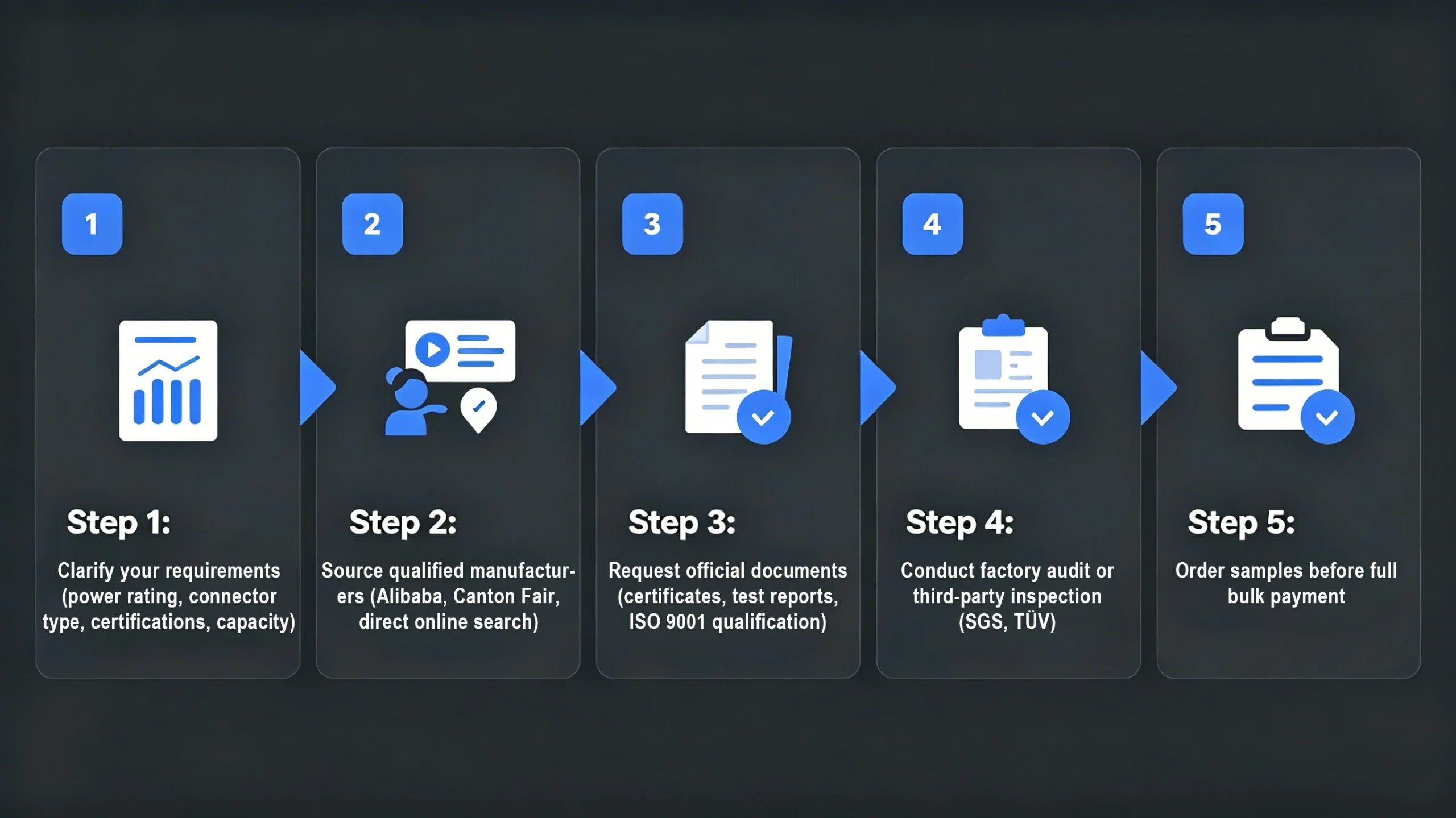
Step 1: Define Your Requirements
Before searching, create a precise specification document covering:
- Charger type (AC or DC) and power rating
- Connector standards for your market (Type 2, CCS1, CCS2, CHAdeMO, etc.)
- Certifications required for your destination country
- Estimated annual order volume
- Smart features required (OCPP compliance, app management, remote monitoring)
- Packaging requirements (industrial crates vs. standard cartons)
A clear specification lets you evaluate suppliers accurately and eliminates costly misunderstandings during production.
Step 2: Identify Manufacturers
Primary sourcing channels:
- Canton Fair (Guangzhou) — China’s largest trade exhibition, held twice annually, enables direct face-to-face meetings with manufacturers
- Alibaba and Global Sources — useful for initial identification, but require careful verification before any payment
- Industry-specific EV trade shows — increasingly common in Europe, the Middle East, and Southeast Asia
- Direct manufacturer websites — established manufacturers with global export experience typically maintain professional, detailed websites with product documentation
For a detailed framework on evaluating Chinese EV charger manufacturers — including factory audit checklists and supplier red flags — our China EV charger manufacturer buyer’s guide covers the full due diligence process.
Step 3: Verify Documentation
Request the following from any supplier under consideration:
- Valid product certifications (CE, UL, RCM, or your required market certification)
- ISO 9001 quality management certificate
- Third-party factory audit report (SGS, TUV, Bureau Veritas, or equivalent)
- Product test reports from accredited testing laboratories
- Commercial registration and manufacturing license
Mini-story: James, a charging station developer in the Netherlands, shortlisted three Chinese AC charger suppliers. Two provided glossy brochures with “CE Certified” stamped on the cover. The third provided the actual TUV certificate number, a recent factory audit report from SGS, and invited James to a live video tour of their production line. He ordered 10 sample units from the third supplier, had them tested by an accredited Dutch laboratory, and confirmed they matched the certification exactly. Two years later, he has deployed 400 units across his network. Zero product failures. The extra two weeks of verification he spent upfront has paid for itself many times over.
Step 4: Conduct a Factory Audit or Third-Party Inspection
For significant orders, a factory audit — either in person or through a third-party inspection company — is a sound investment. Auditors verify production facilities, inspect manufacturing processes, confirm quality controls, and assess the supplier’s actual production capacity.
SGS, Intertek, Bureau Veritas, and similar firms offer factory audit services in China. Cost typically ranges from $500-$1,500 for a standard audit.
Step 5: Order Samples First
Always request physical samples before placing a full production order. Test the sample against your specification, verify connector compatibility, and if required, have it tested by a local accredited laboratory. Confirm the sample matches the certified product documentation before committing to larger volumes.
Red flags that should disqualify a supplier:
- Unusually low prices that suggest recycled or substandard components
- Unwillingness to share factory audit reports or certificate verification details
- No dedicated after-sales or technical support contact for international customers
- Certificate numbers that cannot be verified with the issuing body
- Pressure to place a large order before sampling
Pricing, MOQ, and Payment Terms
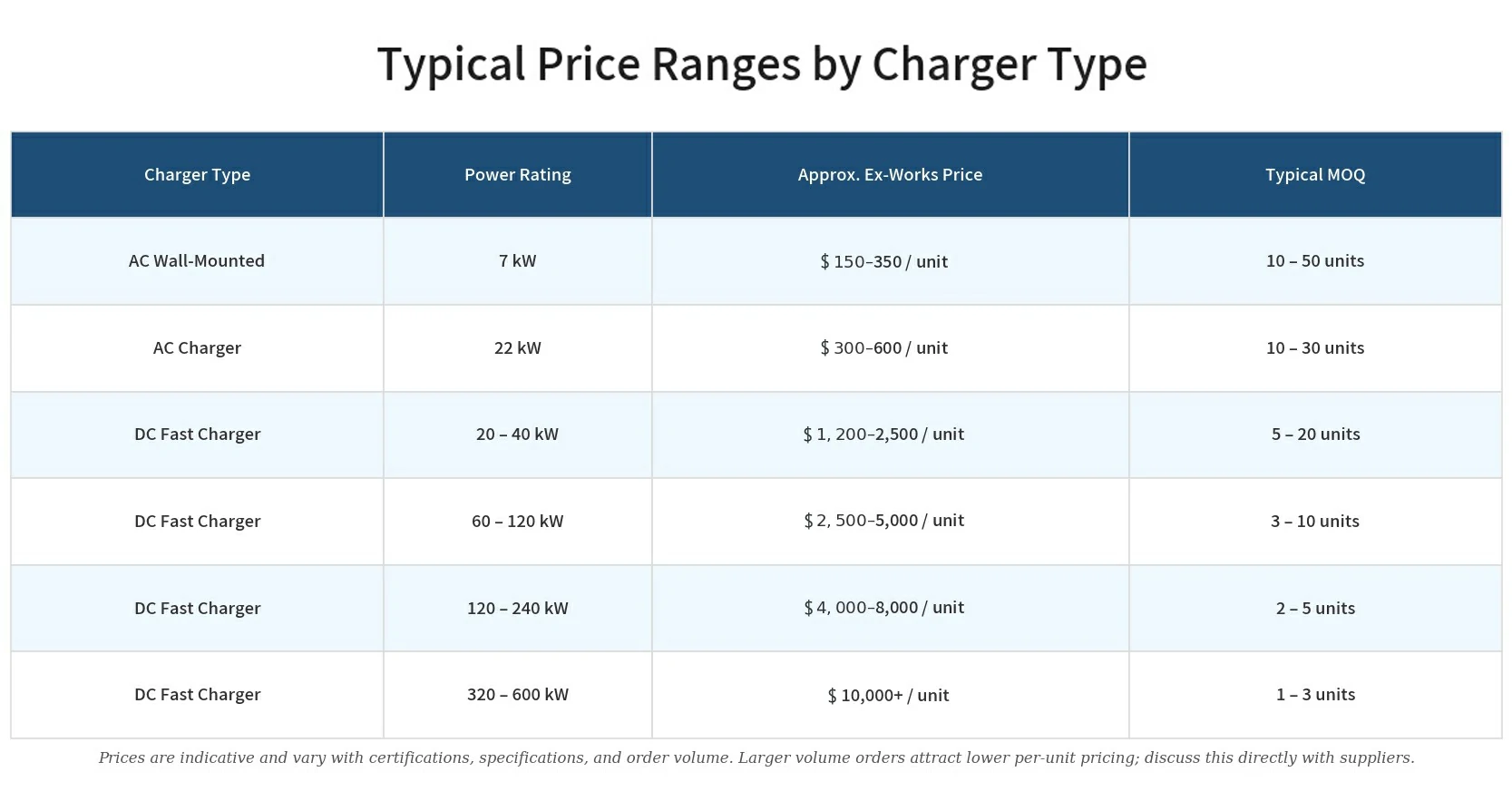
Typical Price Ranges by Charger Type
| Charger Type | Power Rating | Approx. Ex-Works Price | Typical MOQ |
|---|---|---|---|
| AC Wall-Mounted | 7kW | $150-$350/unit | 10-50 units |
| AC Charger | 22kW | $300-$600/unit | 10-30 units |
| DC Fast Charger | 20-40kW | $1,200-$2,500/unit | 5-20 units |
| DC Fast Charger | 60-120kW | $2,500-$5,000/unit | 3-10 units |
| DC Fast Charger | 120-240kW | $4,000-$8,000/unit | 2-5 units |
| DC Fast Charger | 320-600kW | $10,000+/unit | 1-3 units |
Prices are indicative and vary with certifications, specification, and order volume. Larger volume orders attract lower per-unit pricing; discuss this directly with suppliers.
Incoterms: Know Who Pays for What
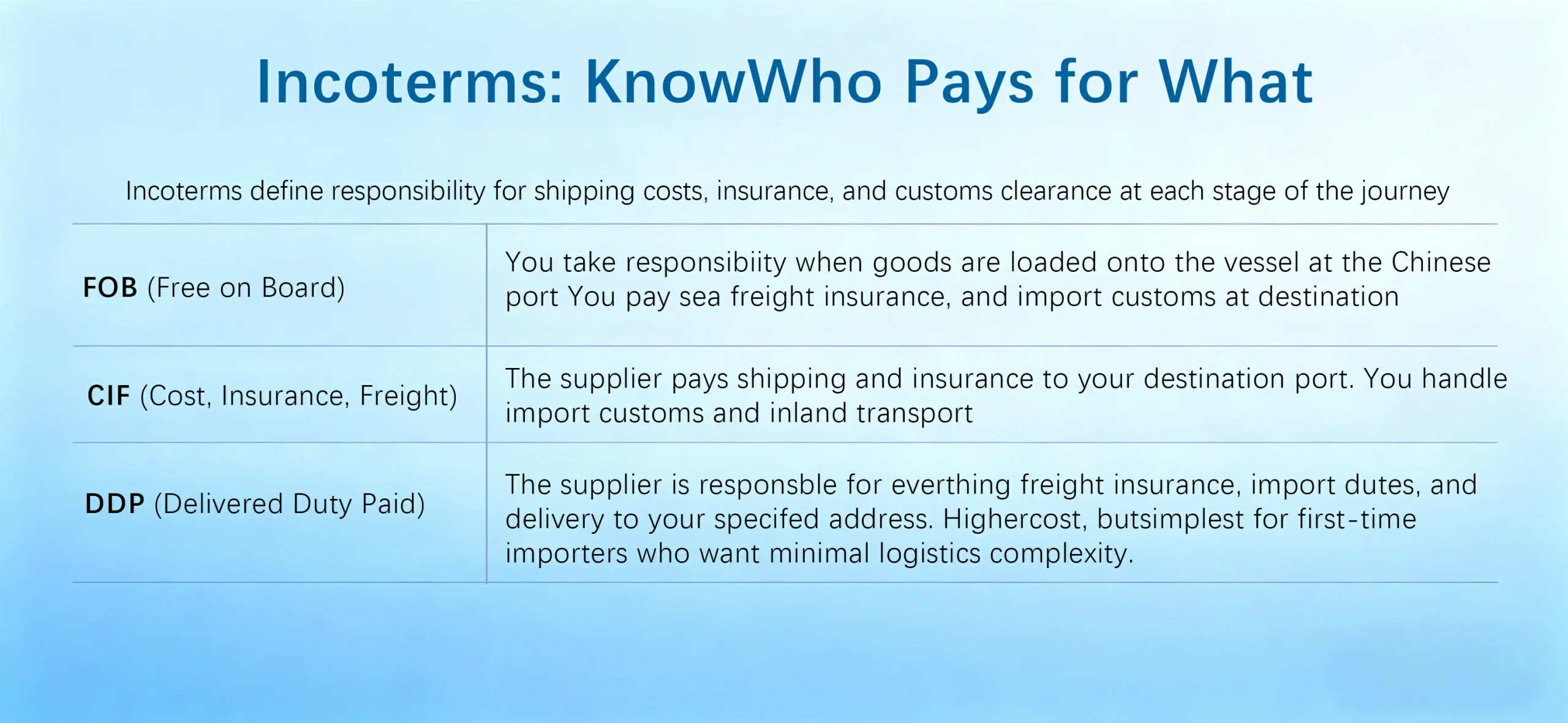
Incoterms define responsibility for shipping costs, insurance, and customs clearance at each stage of the journey.
FOB (Free on Board) — You take responsibility when goods are loaded onto the vessel at the Chinese port. You pay sea freight, insurance, and import customs at destination.
CIF (Cost, Insurance, Freight) — The supplier pays shipping and insurance to your destination port. You handle import customs and inland transport.
DDP (Delivered Duty Paid) — The supplier is responsible for everything: freight, insurance, import duties, and delivery to your specified address. Higher cost, but simplest for first-time importers who want minimal logistics complexity.
Payment Terms
Standard payment terms from Chinese manufacturers:
- T/T (Telegraphic Transfer): Most common. Typically 30% deposit upon order confirmation, 70% balance before shipment
- Letter of Credit (LC): Provides payment security for larger orders; bank-guaranteed payment upon presentation of shipping documents
- Trade Assurance (Alibaba): Provides buyer protection for orders placed through the Alibaba platform
Shipping and Logistics: Getting Chargers to Your Site Safely
EV chargers are heavy, precision electrical equipment. Proper shipping arrangements are as important as the product itself.
Sea Freight vs. Air Freight
Sea freight is the standard and cost-effective method for EV charger imports. Air freight is appropriate only for urgent small samples.
| Factor | Sea Freight | Air Freight |
|---|---|---|
| Cost | Low | 5-8x higher |
| Transit Time | 14-35 days | 3-7 days |
| Best For | All standard orders (5+ units) | Urgent samples only |
| Container Options | LCL (shared) or FCL (full container) | Standard air cargo |
For most buyers, LCL (Less than Container Load) is suitable for orders up to roughly 50 AC chargers or 10-15 DC chargers. Larger orders are more cost-efficient in a dedicated FCL (Full Container Load).
Why Industrial-Grade Packaging Matters
Standard cardboard carton packaging is insufficient for long-distance shipping of electrical equipment. Chargers in standard cartons are vulnerable to compression damage, moisture penetration, and impact during container loading and unloading — particularly over long sea routes.
Industrial-grade wooden crate packaging provides structural protection against compression and impact, moisture barriers for electronics, and secure internal bracing that prevents movement during the entire transit journey. Manufacturers like Yudian supply all international orders in industrial-grade wooden crates as standard, ensuring chargers arrive at any global project site in full working condition ready for installation.
Mini-story: An operations manager for a charging network in the UAE described a common scenario: their first order from a cost-focused supplier arrived with two of eight chargers visibly damaged from inadequate carton packaging. Replacement units took six additional weeks to arrive, delaying their first site opening and costing approximately $12,000 in lost revenue and re-order expense. The replacement order, from a different manufacturer using proper wooden crate packaging, arrived with all 30 units in perfect condition. The packaging upgrade added roughly $15 per unit to the cost.
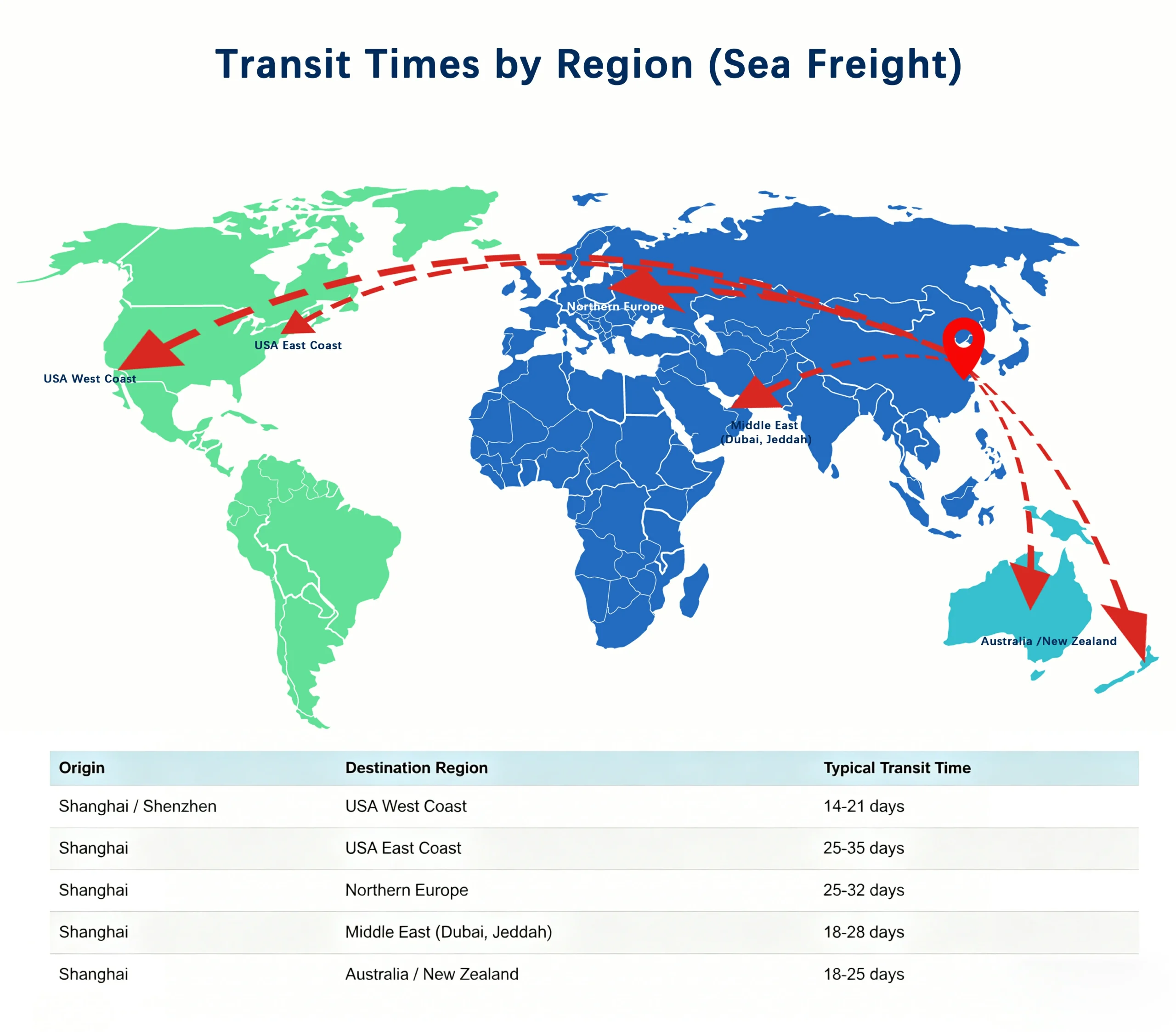
Transit Times by Region (Sea Freight)
| Origin | Destination Region | Typical Transit Time |
|---|---|---|
| Shanghai / Shenzhen | USA West Coast | 14-21 days |
| Shanghai | USA East Coast | 25-35 days |
| Shanghai | Northern Europe | 25-32 days |
| Shanghai | Middle East (Dubai, Jeddah) | 18-28 days |
| Shanghai | Australia / New Zealand | 18-25 days |
Add 3-6 weeks for production lead time before shipment. Plan for a total 6-10 week end-to-end timeline from order confirmation to delivery when scheduling project timelines.
After Import: Installation, Software, and Long-Term Support
The import process does not end when chargers clear customs. Selecting a manufacturer with genuine post-import support capabilities is as important as the hardware itself.
Installation Guidance
Professional EV charger installation requires qualified electricians and proper commissioning. A strong manufacturing partner provides detailed wiring diagrams and installation manuals (in your language), online video guidance or real-time video support for complex installations, and commissioning checklists covering safety verification and functional testing.
Manufacturers with large dedicated engineering teams — such as those with 800+ engineers — can provide responsive, knowledgeable support that generic suppliers or trading companies simply cannot. Ask specifically about international support capabilities before selecting a supplier.
Smart Charging Integration (OCPP 1.6J)
For commercial deployments, chargers must integrate with a Charging Management System (CMS) for billing, monitoring, and smart grid functions. OCPP 1.6J is the industry-standard communication protocol that enables this integration without locking you to a single software platform.
Understanding why OCPP 1.6J is the standard for commercial EV charging is essential knowledge for any operator deploying imported chargers commercially. OCPP compliance ensures you can switch CMS providers, integrate with energy management systems, and support future billing and grid-balancing requirements as your network grows.
Warranty and After-Sales Support
Ask these specific questions before finalizing any supplier:
- What is the warranty period? (Standard for quality manufacturers is 12-24 months)
- How are warranty claims handled for international customers?
- Are spare parts available, and what is the typical lead time for spares?
- Is there a dedicated after-sales contact for international buyers?
A manufacturer that hesitates or provides vague answers on these questions will likely provide poor support when you actually need it.
Ready to discuss your project specifications? Yudian’s engineering team provides consultation on charger selection, certifications, and logistics for international deployments. Contact our team to start the conversation.
Frequently Asked Questions
Q: What certifications do I need to import EV chargers from China?
The required certification depends on your destination market. You need CE marking for Europe, UL 2251 for North America, and RCM for Australia and New Zealand. Always request the original certificate document with the certificate number and verify it directly with the issuing laboratory — UL, TUV Rheinland, SGS, and Intertek all provide online verification tools.
Q: What is the HS code for EV chargers imported from China?
EV charging equipment is generally classified under HS 8504.40 (static converters and electrical equipment). This is a different classification from complete electric vehicles (HS 87.03) and carries significantly lower import duty rates. Confirm the exact HS subheading for your specific product with a licensed customs broker before finalizing your cost model.
Q: Are EV chargers from China subject to the 100% US tariff on Chinese EVs?
No. The 100% Section 301 tariff applies specifically to complete electric vehicles. EV chargers (EVSE) fall under a different HS code and are subject to Section 301 List 3 tariffs, which typically range from 7.5-25% depending on product classification. This distinction is frequently misunderstood and causes significant cost calculation errors for first-time importers.
Q: What is the typical MOQ for importing EV chargers from China?
Most manufacturers set minimum order quantities of 10-50 units for AC chargers and 5-20 units for DC fast chargers. MOQs are often negotiable for first orders, particularly where the buyer can demonstrate a credible plan for ongoing business. Requesting 1-10 sample units before committing to a full order is standard practice, and most reputable manufacturers accommodate this.
Q: How long does it take to import EV chargers from China by sea?
Transit times vary by destination: 14-21 days to the US West Coast, 25-35 days to Europe, and 18-28 days to the Middle East. Production lead time adds a further 3-6 weeks before shipment. Plan for a total of 6-10 weeks from order confirmation to delivery when building your project schedule.
Q: How do I verify that a Chinese EV charger manufacturer’s certifications are genuine?
Request the complete certificate document, including the certificate number, issuing laboratory, and expiry date. Then use the laboratory’s own online verification tool to confirm the certificate is current and matches your product model. UL, TUV Rheinland, SGS, and Intertek all provide these tools at no cost. Do not accept photocopied certificates, expired certificates, or certificates where the model number differs from your order.
Conclusion: Import EV Chargers from China with Confidence
Importing EV chargers from China is a proven, cost-effective route for charging station operators and infrastructure project developers worldwide. The key is following a structured process that reduces risk at every stage — from specification to delivery.
Seven steps to a successful import:
- Define your requirements precisely — charger type, power, connectors, certifications
- Identify and shortlist manufacturers using Canton Fair, trade databases, and direct research
- Verify all certifications — request documents and confirm with issuing laboratories
- Understand your tariff obligations — confirm HS code and duty rate with a customs broker
- Place a sample order before committing to full production volumes
- Arrange logistics with sea freight and industrial-grade packaging, allowing 6-10 weeks end-to-end
- Confirm after-sales support — warranty terms, spare parts availability, and technical guidance
For a deeper analysis of what separates reliable Chinese EV charger manufacturers from lower-quality alternatives, our China EV charger manufacturer buyer’s guide covers every stage of the supplier selection process. And before finalizing your power level and deployment model, our EV charging ROI guide provides financial benchmarks from 7kW to 720kW.
Yudian has been delivering reliable EV charging solutions for international projects since 2002. With a 20,000㎡ factory, 800+ professional engineers, and industrial-grade wooden crate packaging as standard for all international orders, we provide the documentation, product quality, and ongoing support that global project developers require. Contact our team to discuss your specifications, certifications, and delivery requirements.