
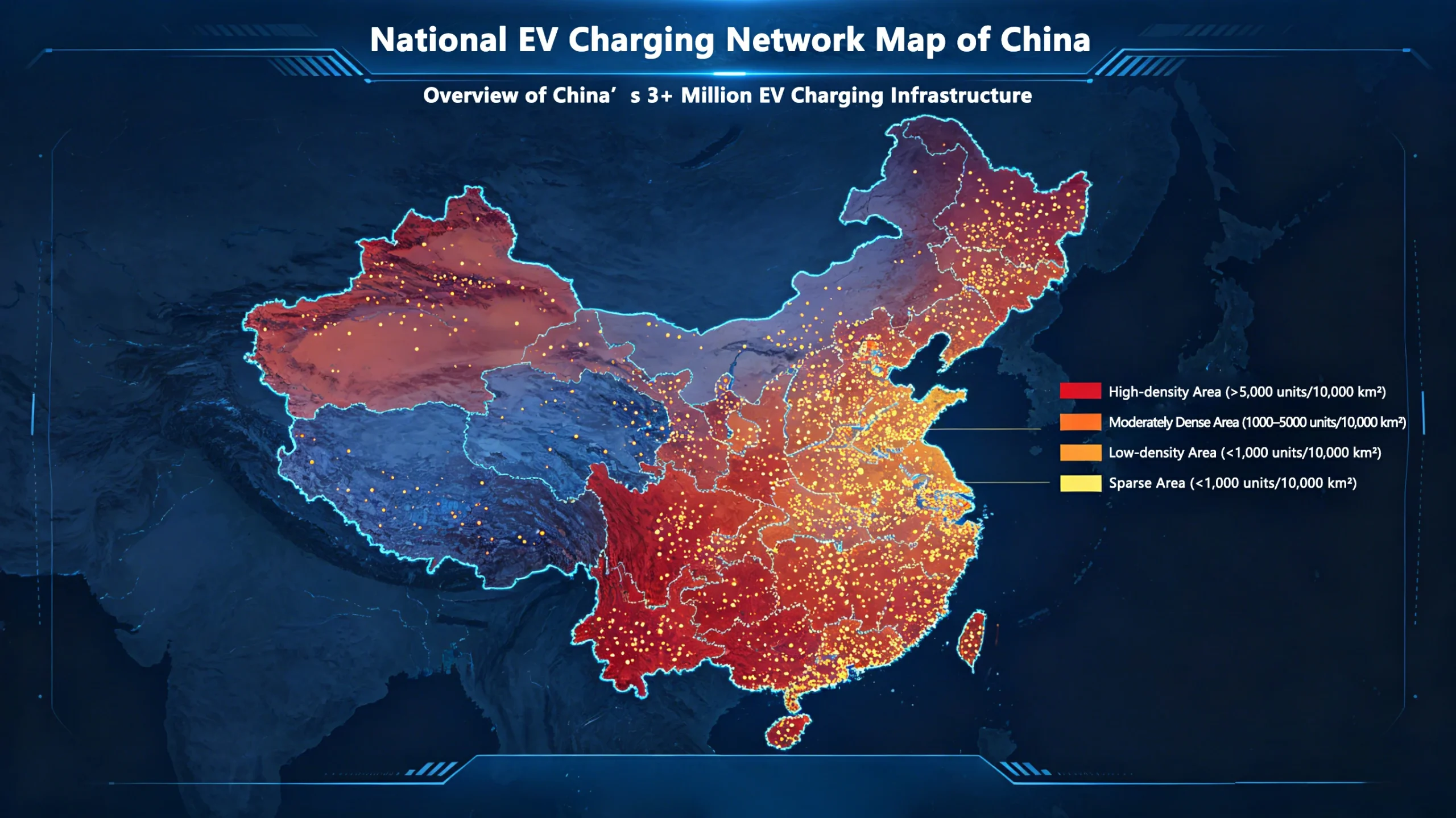
China’s EV charging standard is GB/T 20234, a mandatory national standard that governs all EV charging infrastructure sold and deployed in China. It uses separate connectors for AC and DC charging — unlike CCS, which combines them — and its next-generation evolution, ChaoJi, supports up to 1.2 megawatts of charging power with backward compatibility for existing GB/T hardware.
If you are sourcing EV chargers from China, deploying charging infrastructure for Chinese EV brands, or planning an international project with Chinese-manufactured equipment, understanding GB/T is the foundation of every product specification, compliance requirement, and compatibility decision you will make.
Last year, a project development team in Eastern Europe won a contract to deploy 80 DC fast chargers for a logistics fleet operator. They sourced the hardware from a Chinese manufacturer: competitive pricing, strong specs on paper, and OCPP 1.6J compliance confirmed. Eight weeks later, the chargers arrived on site. The DC connectors were GB/T standard. The fleet ran entirely on CCS2-compatible vehicles. The project stalled for 11 weeks while the team sourced certified adapters, re-tested the installations, and renegotiated their deployment timeline with the client. The total cost of delay exceeded the savings from the original sourcing decision.
That outcome is preventable. It traces directly to one gap: not knowing what China’s EV charging standard is, how it differs from the standard in your market, and what to specify before an order is placed.
This guide closes that gap.
Key Takeaways
- China’s EV charging standard is GB/T 20234, mandatory for all EVs and public charging infrastructure in China. AC and DC charging use entirely separate connectors.
- GB/T AC supports up to 27.7 kW; GB/T DC supports up to 237.5 kW in current mainstream infrastructure, and up to 1,200 kW with the 2023 revision for ChaoJi-capable hardware.
- ChaoJi, approved September 2023, is China’s next-generation standard: 1.2 MW maximum power, backward compatible with GB/T via adapter, and compatible with CHAdeMO 3.1.
- GB/T is not cross-compatible with CCS or NACS without adapters. Chinese EVs exported to Europe use CCS2; exports to North America use CCS1 or NACS.
- When ordering chargers from a Chinese manufacturer for an international project, always specify your required connector standard (CCS2, CCS1, NACS) explicitly in writing before production begins.
What Is the China EV Charging Standard (GB/T)?
The China EV charging standard is GB/T 20234, a series of national standards governing connector design, communication protocols, and safety requirements for all EV charging equipment manufactured or operated in China.
“GB/T” is an abbreviation of Chinese “recommended national standard.” Despite the word “recommended,” GB/T 20234 is effectively mandatory: every EV sold on the Chinese domestic market and every public charging point installed in China must comply with it. The standard is governed by the Standardization Administration of China (SAC) and the National Automobile Standardization Technical Committee.
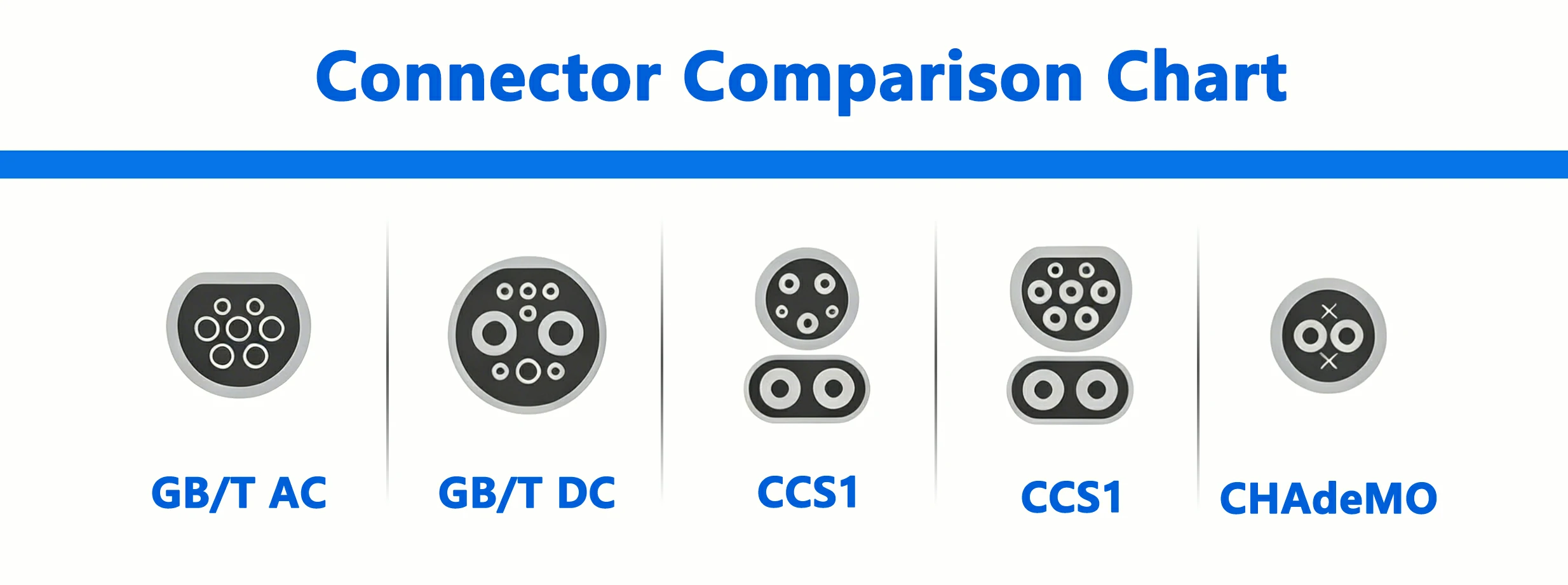
The most critical thing to understand about GB/T is its dual-connector architecture. Unlike CCS (Combined Charging System), which uses a single inlet for both AC and DC charging, GB/T uses two completely separate connectors: one for AC and one for DC. As a result, every Chinese-market electric vehicle has two charging ports. Chinese-market chargers similarly come as two separate product categories — AC chargers and DC chargers — each with distinct GB/T connectors.
The standard has been revised twice: once in 2015 and again in 2023 (GB/T 20234.1-2023 for general requirements; GB/T 20234.3-2023 for DC charging interface). The 2023 revision raised the DC voltage ceiling to 1,500V and maximum current to 800A, enabling theoretical power delivery of up to 1,200 kW for next-generation ultra-high-power applications.
China operates the world’s largest EV charging network: more than 3 million public charging points, all built on GB/T. With China representing more than 60% of global EV sales, GB/T is by volume the highest-throughput charging standard in the world — even though it is rarely deployed outside China’s borders.
GB/T AC vs DC: Two Connectors, Two Use Cases
Understanding GB/T means understanding that AC and DC charging operate as separate systems. Each serves a different operational purpose, and the connector types are not interchangeable.
GB/T AC Charging (GB/T 20234.2)
GB/T AC charging uses a 7-pin connector and is designed for slower, long-dwell scenarios: residential installations, workplace charging, hotel parking facilities, and destination charging sites where vehicles park for several hours.
Technical specifications:
- Single-phase: up to 250V / 32A (~7.4 kW)
- Three-phase: up to 440V / 63A (~27.7 kW)
- Typical deployment: 7 kW and 22 kW wall-mounted units
In commercial projects, 7 kW AC chargers are the standard choice for any location where average dwell time exceeds two hours. Yudian’s 7kW smart AC EV charger is built to GB/T 20234.2 and supports app-based scheduling and remote monitoring for operators managing multiple units.
GB/T DC Fast Charging (GB/T 20234.3)
GB/T DC fast charging uses a 9-pin connector and is designed for public fast charging stations, fleet depots, and any scenario where vehicles need a substantial charge in under an hour.
Technical specifications (post-2023 revision):
- Maximum voltage: 1,500V
- Maximum current: 800A
- Maximum power: 1,200 kW (ChaoJi-capable configurations)
- Current mainstream deployment: up to 237.5 kW (1,000V / 250A)
The 60-240 kW range covers the majority of commercial fast charging projects globally. Yudian’s 60-80kW DC fast charger and 120-240kW DC EV charger ranges are manufactured to GB/T 20234.3 for domestic deployment and can be configured with CCS2 or other connector types for export projects.
GB/T vs CCS vs CHAdeMO: Global Standard Comparison
The global EV fast charging landscape is shaped by three primary standards: GB/T, CCS, and CHAdeMO. Understanding their differences is essential for any international procurement or deployment decision.
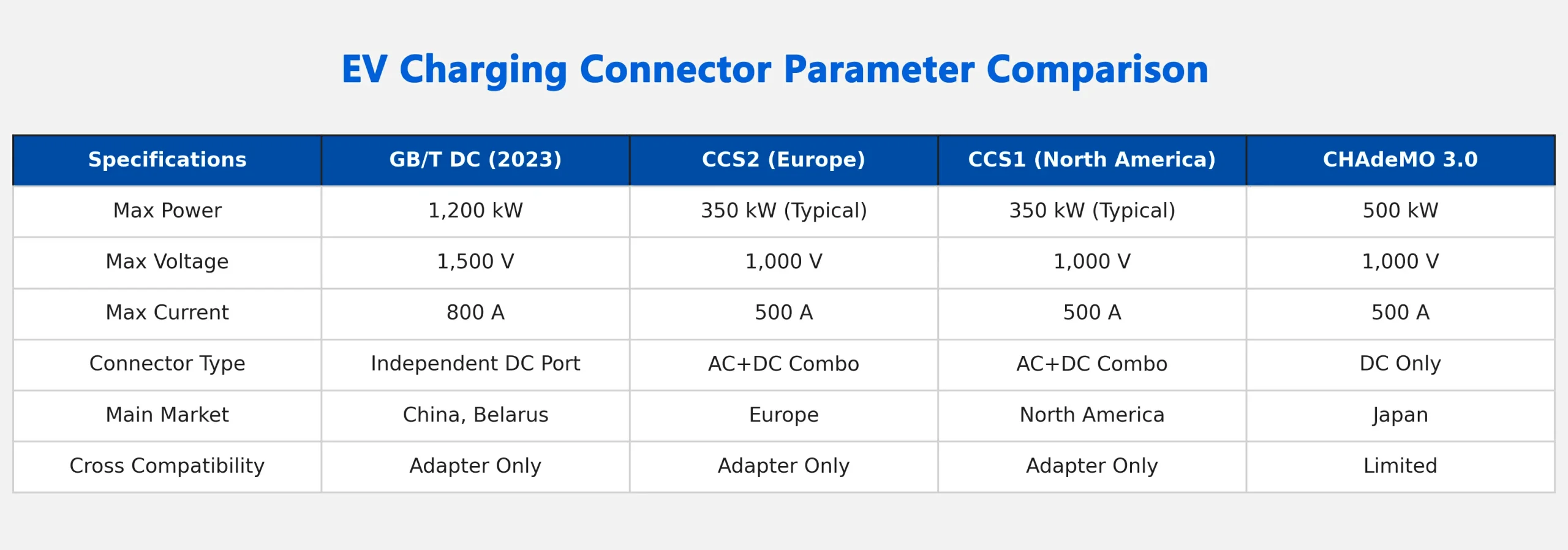
| Parameter | GB/T DC (2023) | CCS2 (Europe) | CCS1 (N. America) | CHAdeMO 3.0 |
|---|---|---|---|---|
| Max Power | 1,200 kW | 350 kW (typical) | 350 kW (typical) | 500 kW |
| Max Voltage | 1,500V | 1,000V | 1,000V | 1,000V |
| Max Current | 800A | 500A | 500A | 500A |
| Connector Type | Separate DC port | Combined AC+DC | Combined AC+DC | Separate DC only |
| Primary Region | China, Belarus | Europe | N. America | Japan |
| Cross-Compatible | Adapter only | Adapter only | Adapter only | Limited |
Incompatibilities that affect procurement decisions:
GB/T and CCS are not cross-compatible without adapters. A CCS2-equipped vehicle cannot use a GB/T DC charger without a certified adapter, and vice versa. Chinese EV brands exported to Europe — BYD, NIO, Xpeng — are fitted with CCS2 inlets, not GB/T. Chinese EVs exported to North America use CCS1 or NACS. Meanwhile, as of 2026, approximately 95% of new EV models sold outside Japan and China use CCS for DC fast charging.
The CHAdeMO standard, once dominant in Japan, has been losing ground globally. Its most relevant connection to GB/T is through the ChaoJi standard, discussed in the next section.
For operators planning a deployment: the connector on your charger must match the charging inlet on the EVs you are serving. If you are deploying in China for Chinese-market vehicles, you need GB/T. If you are deploying internationally for CCS2 vehicles, you need CCS2. Getting this wrong at the order stage creates exactly the kind of multi-month delay described at the start of this article.
> Planning a project with mixed connector requirements? Yudian’s engineering team provides pre-order specification support to confirm connector compatibility before production. Contact us to discuss your project.
ChaoJi: China’s Next-Generation Ultra-High-Power Standard
ChaoJi is the next-generation DC charging standard developed jointly by China (through the Standardization Administration of China) and Japan (through the CHAdeMO Association). It was formally approved in September 2023 by China’s State Administration for Market Regulation — representing a significant milestone in both domestic and international EV charging standardization.
ChaoJi technical profile:
- Maximum power: 1,200 kW (1,500V x 800A)
- Backward compatible with existing GB/T DC infrastructure via adapter
- Compatible with CHAdeMO 3.1 via adapter
- Under development for IEC international standardization
ChaoJi matters for infrastructure investment decisions because it defines China’s charging ceiling for the next decade. In March 2026, BYD launched its Flash Charging system — rated at up to 1,500 kW through a single connector, more than four times faster than Europe’s current 350 kW maximum at public charging stations. BYD has announced plans to deploy 20,000 ChaoJi-capable stations across China by the end of 2026.
What ChaoJi means for your investment decisions:
If you are deploying long-term charging infrastructure in China, specifying ChaoJi-ready hardware ensures compatibility with the next generation of ultra-high-power EVs entering the market. If you are deploying internationally for CCS2 or NACS fleets, ChaoJi is not currently relevant — those markets use different standards at different power levels.
The backward compatibility guarantee is important for existing operators: GB/T DC chargers already deployed will continue to function with ChaoJi-equipped vehicles via adapter. There is no stranded-asset risk for operators with existing GB/T DC infrastructure.
For a comprehensive look at the technology developments shaping China’s fast charging market in 2026, including BYD Flash Charging, CATL battery swap, and next-generation liquid-cooled hardware, see our article on China EV fast charging developments 2026.
Which Countries Use the GB/T Standard?
GB/T 20234 is the mandatory standard in China and Belarus. No other country has adopted GB/T as a primary national standard for domestically sold EVs or public charging infrastructure.
That said, GB/T chargers are deployed in additional markets in specific circumstances:
- Emerging markets with Chinese EV fleet imports: Some operators in Southeast Asia, parts of the Middle East, and Sub-Saharan Africa have deployed GB/T chargers to support Chinese-market vehicles imported for local fleet or taxi use.
- Chinese-funded infrastructure projects: Some infrastructure projects co-funded with Chinese partners have included GB/T-standard charging as part of the initial build.
- Belarus: The only country outside China with a formal GB/T mandate, aligned with its use of Chinese-market vehicles.
For most international deployments — Europe, North America, Australia, the Gulf region, and most of Asia-Pacific — the relevant standard for new infrastructure is CCS2 or CCS1, not GB/T.
The practical implication: if you are sourcing chargers from a Chinese manufacturer for an international project, you must specify your required connector standard when placing the order. Most established Chinese charger manufacturers produce both domestic GB/T configurations and export configurations with CCS2, NACS, or dual-standard options. Yudian maintains dedicated export production lines with CCS2 and other connector configurations for international projects. Our full guide to importing EV chargers from China covers the complete documentation, certification, and customs process for international buyers.
What GB/T Compliance Means When Sourcing Chargers from China
Here is where the standard moves from technical knowledge to purchasing practice.
When a Chinese manufacturer states that their product is “GB/T compliant,” it means the charger has been designed and tested to meet the GB/T 20234 connector, communication, and safety specifications for the Chinese domestic market. For international buyers, this raises questions that must be answered before any order is placed.
Consider this scenario: a procurement manager in Chile was sourcing 30 DC fast chargers for a national highway charging corridor. She received quotes from four Chinese suppliers, all stating “GB/T 20234 compliant, OCPP 1.6J.” She selected one based on price and delivery timeline. On follow-up, she asked one additional question: “Can you confirm the physical connector is CCS2 for our CCS2 fleet?” The answer came back: the unit was GB/T DC as standard, with CCS2 available as a custom export configuration requiring a four-week lead time adjustment. That single question, asked before the order was signed, saved her project from the same outcome as the Eastern European fleet operator.
Three compliance points that matter most for buyers:
The 2023 revision defines the current ceiling. If you are ordering DC fast chargers above 100 kW, ask your supplier whether the product meets the 2023 revision of GB/T 20234.3 (supporting 1,500V / 800A) or the older 2015 revision (1,000V / 250A). For forward-looking infrastructure, the 2023 revision compliance is the correct specification.
CQC certification is the verifiable proof. The China Quality Certification Centre (CQC) certification confirms that a product has been independently tested against GB/T standards. A supplier claiming GB/T compliance without providing a CQC certificate and the specific standard version number is making an unverifiable claim. Request this document as part of your pre-order due diligence.
Communication protocols are separate from connectors. A charger can be physically GB/T-compliant while also running OCPP 1.6J for backend management. For commercial operators, OCPP compatibility is a separate specification requirement from connector type. Our article on why OCPP 1.6J is the standard for commercial EV charging explains how this protocol enables open backend integration and long-term operational flexibility.
How to Verify GB/T Compliance: A Buyer’s 5-Point Checklist
Before placing any order with a Chinese charger manufacturer, use this checklist to verify compliance and confirm your product configuration:
- Request the CQC certificate. Ask for the China Quality Certification Centre document referencing the specific GB/T 20234 part (20234.2 for AC connector, 20234.3 for DC connector). Confirm the revision year on the certificate — 2015 or 2023. For DC fast chargers, the 2023 revision is the current standard.
- Confirm your connector standard in writing. State explicitly whether you need GB/T AC, GB/T DC, CCS2, CCS1, NACS, or a dual-standard configuration. Get this confirmed in the product specification sheet before production starts, not after.
- Verify revision compliance for high-power units. For any DC fast charger above 100 kW, confirm whether the unit is designed to the 2023 GB/T 20234.3 revision (1,500V / 800A ceiling) or the 2015 revision (1,000V / 250A ceiling). This affects both current performance and future ChaoJi compatibility.
- Obtain OCPP compliance documentation separately. If your project requires OCPP 1.6J for central management system integration, request the OCPP certification or test report as a separate document. OCPP is a communication protocol standard — it is distinct from GB/T physical compliance.
- Review quality inspection and packaging documentation. Ask for the internal QC inspection process and packaging specifications. Industrial-grade packaging protects equipment during international shipping; a rigorous QA process ensures the unit arriving on site matches the specification on paper.
For a comprehensive framework for evaluating Chinese charger manufacturers beyond compliance documentation — including factory audits, reference checks, and contract protections — see our China EV charger manufacturer buyer’s guide.
Frequently Asked Questions: China EV Charging Standard
Q: What charging standard does China use for EVs?
China uses GB/T 20234, a mandatory national standard governing both AC and DC EV charging. It requires separate connectors for AC slow charging and DC fast charging, managed under different parts of the standard (GB/T 20234.2 for AC connectors, GB/T 20234.3 for DC connectors).
Q: Is GB/T the same as CCS?
No. GB/T and CCS are incompatible standards without adapters. GB/T uses separate AC and DC connectors specific to the Chinese market. CCS (Combined Charging System) uses a single combined inlet for AC and DC and is dominant in Europe (CCS2) and North America (CCS1). The two systems cannot be used interchangeably without a certified adapter.
Q: Can I use a GB/T charger outside China?
GB/T chargers are compatible with Chinese-market EVs fitted with GB/T inlets. In most international markets, EV fleets use CCS2, CCS1, or NACS. A GB/T charger would only serve vehicles with a matching GB/T inlet — which outside China is typically limited to Chinese-market vehicles that have not been converted for export.
Q: Will ChaoJi replace GB/T?
ChaoJi is the next-generation evolution of GB/T, not an immediate replacement. It is backward compatible with existing GB/T DC infrastructure via adapter. Adoption will accelerate as ultra-high-power vehicles (above 350 kW charging capability) enter the Chinese market. Existing GB/T DC hardware is not made obsolete by ChaoJi.
Q: Do exported Chinese EVs still use GB/T?
No. Chinese EV manufacturers adapt their vehicles for export markets. EVs exported to Europe receive CCS2 inlets; those exported to North America receive CCS1 or NACS. GB/T connectors are retained only in the Chinese domestic market specification.
Q: How much power does GB/T DC charging support?
Current mainstream GB/T DC public infrastructure supports up to 237.5 kW (1,000V x 250A). The 2023 revision of GB/T 20234.3 enables up to 1,200 kW (1,500V x 800A) for ChaoJi-capable hardware and vehicles. BYD’s Flash Charging system, launched in March 2026, delivers up to 1,500 kW through a proprietary high-power implementation.
Conclusion
The China EV charging standard — GB/T 20234 — underpins the world’s largest EV charging network. Understanding its two-connector architecture, its 2023 revision, and its relationship to ChaoJi is not background knowledge for procurement teams: it is the practical foundation for avoiding the compatibility failures, project delays, and cost overruns that stem from under-specified orders.
The key facts to carry forward: GB/T is mandatory in China and uses separate connectors for AC and DC charging. It is not compatible with CCS or NACS without adapters. ChaoJi extends the standard’s power ceiling to 1.2 MW with backward compatibility. And when sourcing chargers from a Chinese manufacturer for any international project, your connector requirement must be specified in writing before production starts.
At Yudian, our engineering team has supported EV charging deployments across multiple regions, including projects requiring GB/T, CCS2, and custom connector configurations. Every unit we produce passes rigorous internal quality checks and is packed in industrial-grade wooden crates to ensure safe arrival at your project site. Our 800+ professional engineers are available for pre-order technical consultation, specification support, and installation guidance throughout your project.
Ready to discuss your project’s specifications? Contact Yudian’s team for a technical consultation, product configuration advice, or a formal quotation for your next EV charging deployment.
—
Sources: Standardization Administration of China (GB/T 20234 series); CHAdeMO Association, ChaoJi GB/T Standards Release; electrive.com, China Approves New DC Charging Standard ChaoJi-1; Wikipedia, GB/T Charging Standard