
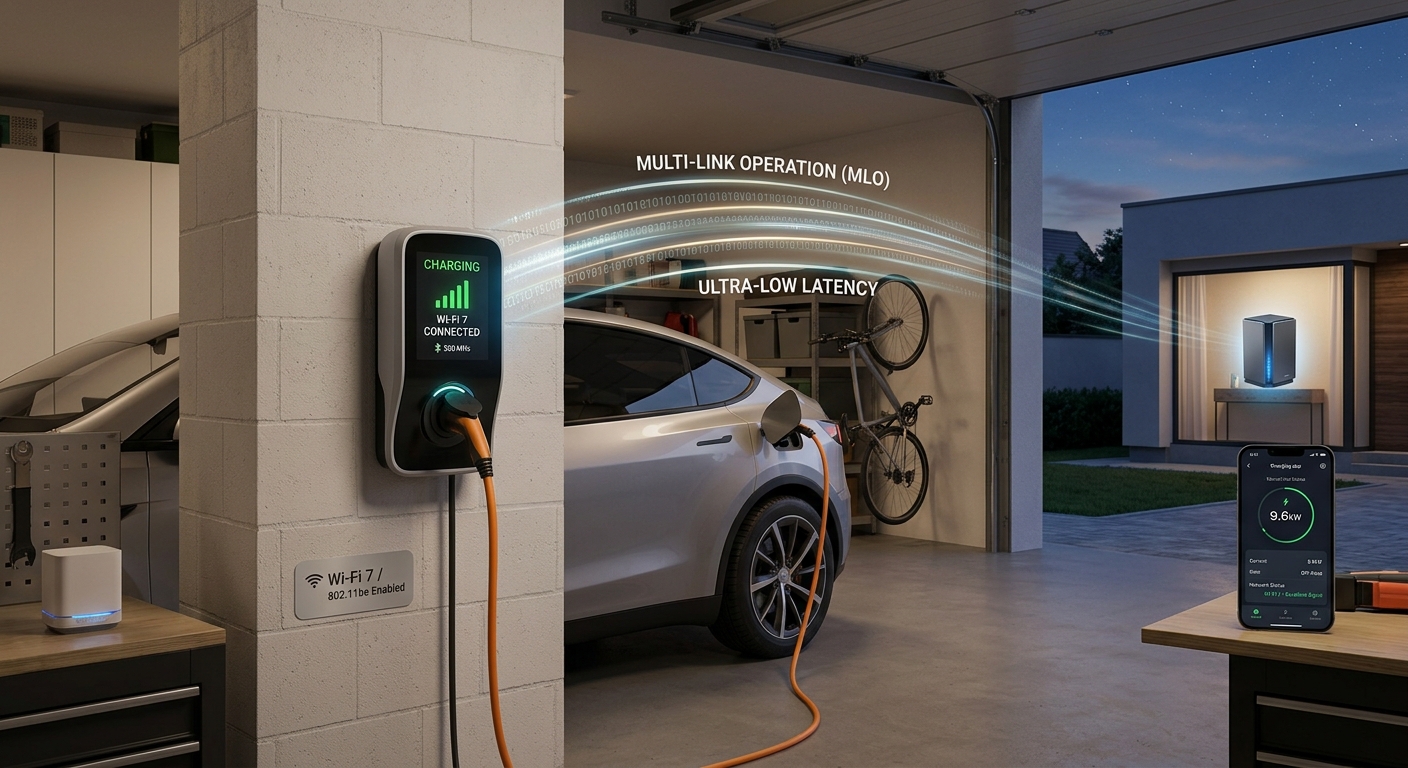
As electric vehicles (EVs) rapidly transition from niche innovations to mainstream transportation, the demand for reliable, intelligent home charging infrastructure has never been higher. Today’s EV owners expect far more from a home charger than just a basic electrical outlet. Modern Level 2 chargers are sophisticated Internet of Things (IoT) endpoints equipped with dynamic load balancing, real-time grid communication, automated scheduling, and solar energy synchronization. However, as EV chargers become more integrated into smart home ecosystems, they expose a critical vulnerability in many households: network bandwidth and signal reliability.
To ensure seamless communication between your charger, mobile app, energy management system, and cloud server, a robust and forward-looking wireless network is essential. This is where Wi-Fi 7 (802.11be) technology comes into play, revolutionizing how smart chargers maintain connectivity in challenging home environments.
Why Smart EV Chargers Need Robust, High-Speed Connectivity
Unlike standard appliances located inside the main living areas of a home, EV chargers are almost exclusively installed in perimeter zones—such as detached garages, outdoor carports, or exterior walls. These areas present severe radio frequency (RF) challenges, including thick concrete or brick walls, metallic garage doors, and distance from the primary router. When combined with an increasing number of connected smart home devices, traditional Wi-Fi networks frequently suffer from packet loss, high latency, and dropped connections.
A weak or inconsistent connection can impair your smart charging setup in several critical ways:
- Delayed Grid & Tariff Response: Many utility companies offer time-of-use (TOU) rate plans, enabling EV owners to charge during off-peak hours when electricity is cheapest. If network latency delays the start signal or misaligns the charging schedule, you risk charging your vehicle during peak hours, significantly increasing your energy bill.
- Dynamic Load Balancing (DLB) Failure: DLB monitors your home’s real-time electricity consumption and dynamically throttles the EV charger’s power draw to prevent main breaker overloads. If communication between the smart meter, home energy management system, and charger lags, the safety mechanism may fail or cause false trips.
- Interrupted Firmware & OTA Updates: Over-the-air (OTA) updates are vital for maintaining charger security, bug fixes, and feature enhancements. A dropped connection mid-update can result in software corruption, rendering the charger temporarily inoperable.
The Wi-Fi 7 Advantage: Revolutionizing Smart Home Infrastructure
The introduction of Wi-Fi 7 (IEEE 802.11be) marks a monumental leap in wireless networking, engineered specifically to handle dense device environments and high-bandwidth, low-latency requirements. By deploying a high-performance Wifi 7 Router, homeowners can eliminate coverage dead zones and extend reliable coverage directly to their garage or driveway.
Key technological breakthroughs in Wi-Fi 7 that directly benefit smart EV charging include:
- Multi-Link Operation (MLO): Legacy Wi-Fi routers require devices to connect over a single frequency band (2.4 GHz, 5 GHz, or 6 GHz). MLO allows a device to simultaneously send and receive data across multiple bands. If one band experiences interference from garage door openers or neighboring networks, traffic instantly reroutes without dropping the connection.
- 4096-QAM & 320 MHz Channels: Higher quadrature amplitude modulation (QAM) and wider channel bandwidth dramatically increase data transmission rates, allowing your router to punch through dense building materials with cleaner, more resilient signals.
- Preamble Puncturing & Multi-RU: In congested environments, traditional Wi-Fi blocks entire channels if any portion experiences interference. Wi-Fi 7 “punctures” around interference, utilizing available spectrum efficiency to ensure real-time signals reach outdoor endpoints without delay.
- Ultra-Low Latency & IoT Prioritization: Modern Wi-Fi 7 routers feature advanced Quality of Service (QoS) protocols, guaranteeing that critical power control signals receive priority over casual media streaming or downloads.
Building a Future-Proof Energy Management Ecosystem
Integrating a high-speed Wi-Fi 7 network with your home EV charging station forms the foundation of a modern Home Energy Management System (HEMS). When your charger, rooftop solar panels, battery storage, and smart appliances communicate instantaneously across a unified network, you gain total control over your energy consumption.
Whether you are setting up dynamic solar charging—where your EV charges purely on excess solar power—or coordinating multi-EV charging setups in a shared driveway, the rock-solid connection provided by Wi-Fi 7 ensures every data packet arrives instantly and securely.
Frequently Asked Questions (FAQ)
1. Do EV chargers support 5 GHz or 6 GHz Wi-Fi bands?
Most current smart EV chargers utilize 2.4 GHz Wi-Fi modules because 2.4 GHz offers better range through walls. However, newer Wi-Fi 7 routers provide vastly improved backward compatibility, range extension features, and multi-band optimization that significantly enhance 2.4 GHz signal quality and stability at long distances.
2. Can I use a Wi-Fi range extender instead of upgrading to a Wi-Fi 7 router?
While a basic range extender can boost signal distance, it often reduces total network bandwidth by half and introduces noticeable latency. For mission-critical tasks like Dynamic Load Balancing and real-time charging control, a native Wi-Fi 7 router or a Wi-Fi 7 mesh node in the garage provides significantly lower latency and superior reliability.
3. How does Wi-Fi 7 improve connection reliability through garage walls?
Wi-Fi 7 incorporates advanced beamforming technology and preamble puncturing, allowing the router to focus RF signals directly toward the charger while avoiding radio interference caused by concrete, metal insulation, or neighboring networks.
4. Is Wi-Fi 7 necessary if my charger is connected via Ethernet?
If your EV charger is hardwired with an Ethernet cable, a wireless connection is not strictly necessary for the charger itself. However, a Wi-Fi 7 network remains ideal for surrounding smart home peripherals, smart energy meters, mobile app controls, and wireless sensors that communicate with your charger.
5. Will upgrading to Wi-Fi 7 make my EV charge faster?
Wi-Fi 7 does not increase the physical electrical output (kW) of your EV charger. However, it ensures that smart scheduling, real-time load management, and off-peak charging commands execute without delay, optimizing charging efficiency and saving you money on electricity rates.